

Calciphylaxis
Calcific uraemic arteriolopathy; CUA; uraemic gangrenous syndrome
Calciphylaxis (calcific uraemic arteriolopathy) is a rare but devastating vasculopathy of the small-vessel dermal and subcutaneous arteries — most commonly in end-stage renal disease (ESRD) on dialysis, with non-uraemic variants reported. Mural calcification with intimal hyperplasia and microthrombosis cause cutaneous infarction and progressive necrotic ulceration. Mortality remains around 50–80% at one year. Clinically critical in skin oncology because the necrotic ulcers — particularly on the lower limbs, abdomen and breast — closely mimic cSCC, livedoid vasculopathy, vasculitis or necrotising soft-tissue infection. Treatment combines sodium thiosulphate, correction of calcium-phosphate metabolism, cessation of warfarin and meticulous wound care.
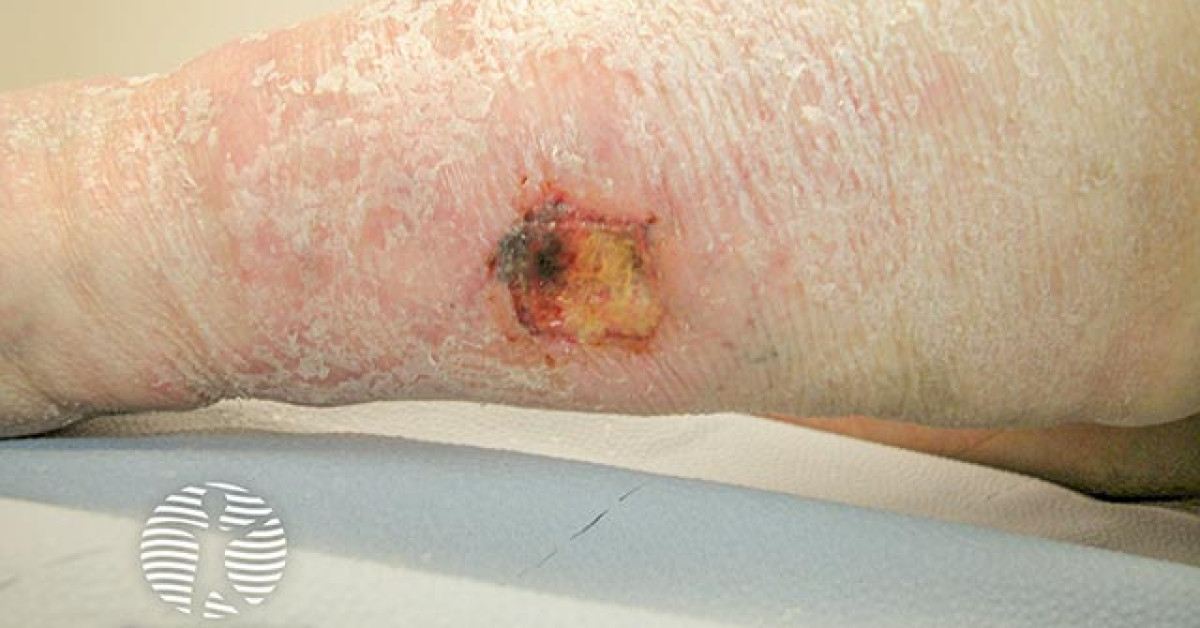
Clinical features
- Painful violaceous patches or plaques progressing rapidly to necrotic, eschar-covered ulcers.
- Net-like, livedoid retiform purpura is characteristic at the periphery.
- Pain is severe and out of proportion to lesion size.
- Two distinct distributions:
- Central (truncal — abdomen, breast, buttock, proximal limb) — worse prognosis.
- Distal / acral (lower limbs, fingers / toes) — typically less severe.
- Wounds expand rapidly; secondary infection common; sepsis is the leading cause of death.
Risk factors
- End-stage renal disease on haemodialysis (commonest setting) or peritoneal dialysis.
- Female sex.
- Obesity.
- Diabetes mellitus.
- Hyperparathyroidism / secondary or tertiary; elevated calcium-phosphate product.
- Warfarin use — inhibits vitamin-K-dependent matrix Gla protein, predisposing to vascular calcification.
- Vitamin K deficiency.
- Hypoalbuminaemia.
- Recent rapid changes in calcium / phosphate / PTH balance.
- Non-uraemic calciphylaxis — primary hyperparathyroidism, malignancy, autoimmune, alcoholic liver disease.
Diagnosis
- Clinical pattern in an at-risk patient is highly suggestive.
- Biopsy — deep punch or incisional from the edge of the lesion:
- Calcium deposits within the walls of small-to-medium-calibre vessels (von Kossa / alizarin red staining).
- Intimal hyperplasia, microthrombi, surrounding panniculitis and dermal necrosis.
- Biopsy carries pathergy / wound-extension risk — discuss risk-benefit; small punch from edge is reasonable.
- Bloods — U&E, calcium, phosphate, calcium-phosphate product, PTH, vitamin D, vitamin K status, INR if on warfarin.
- Imaging — plain radiograph or bone scintigraphy showing soft-tissue and vascular calcification.
- Multidisciplinary input — renal medicine, dermatology, plastic surgery / tissue viability, pain medicine.
Management
- Sodium thiosulphate 25 g IV three times weekly post-dialysis — chelator and antioxidant; first-line UK pharmacological therapy.
- Correct calcium-phosphate balance — low-calcium dialysate, non-calcium phosphate binders (sevelamer, lanthanum), cinacalcet for secondary hyperparathyroidism, parathyroidectomy in selected cases.
- Cessation of warfarin — convert to apixaban or rivaroxaban where anticoagulation indicated.
- Vitamin K supplementation — emerging evidence supports addition.
- Wound care — non-adherent dressings, no aggressive debridement (pathergy risk); hyperbaric oxygen therapy in selected cases.
- Pain control — opioids, ketamine, regional anaesthesia; pain is often debilitating.
- Treatment of sepsis — broad-spectrum antibiotics, surgical drainage where infection requires.
- Multidisciplinary palliative-care input — high mortality and treatment burden often warrant early symptom-management planning.
Prognosis
- One-year mortality 50–80%; central / truncal distribution worse than distal.
- Sepsis from wound infection is the leading cause of death.
- Survivors often have prolonged hospitalisation, repeated debridement and chronic pain.
- Despite low-quality evidence, early multidisciplinary intervention improves outcomes — high index of suspicion is essential.
References
- Nigwekar SU, Thadhani R, Brandenburg VM. Calciphylaxis. N Engl J Med; 2018.
- Hayashi M et al. Sodium thiosulfate in the treatment of calciphylaxis. Clin J Am Soc Nephrol; 2013.
- UK Kidney Association. Calciphylaxis rare renal disease information. UKKA Rare Renal patient and clinician information, accessed 18 May 2026.
Spot a correction?
If any clinical statement, citation or link on this page needs updating, please email admin@skinoncology.net with the page name, the proposed correction and the supporting source.