

Spider naevus
Spider angioma; naevus araneus; arterial spider; vascular spider
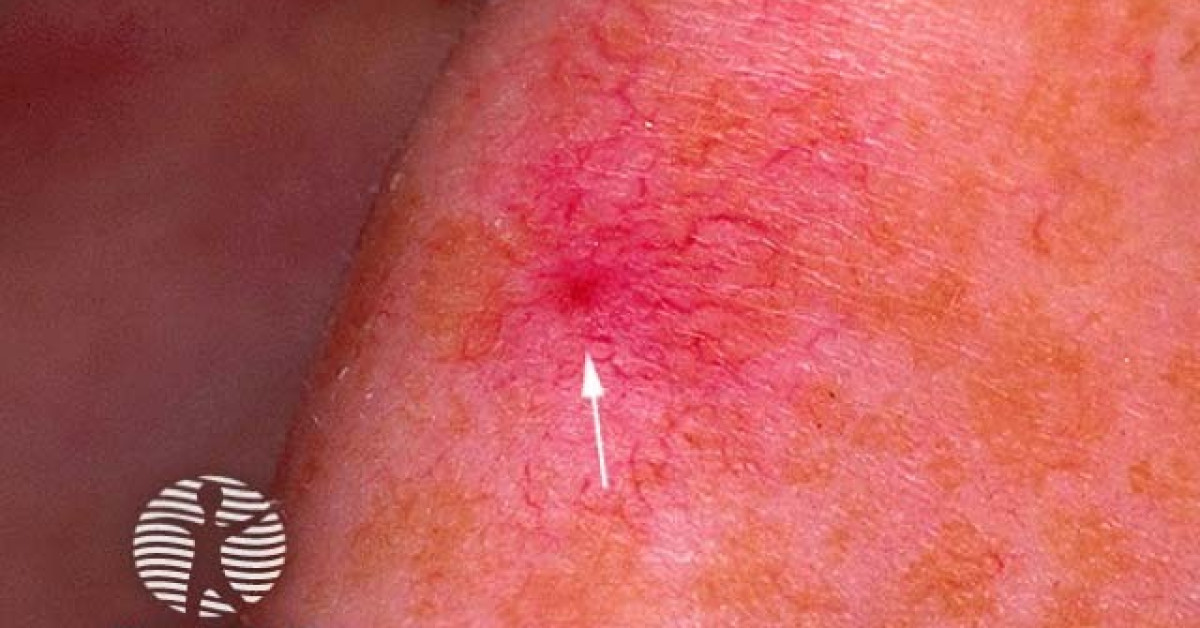
The spider naevus — also called the spider angioma or naevus araneus — is a common acquired vascular lesion characterised by a central pinhead-sized red arteriolar punctum surrounded by symmetrical radiating telangiectatic capillary "legs". The lesion is benign, common in healthy children (~40% prevalence) and pregnant women, and not in itself a marker of disease. The skin-oncology / clinical relevance lies in three contexts: (1) cosmetic concern — patients often present requesting removal; (2) the recognition that multiple new spider naevi in an adult man are a classical clinical sign of chronic liver disease (cirrhosis, alcohol-related liver disease, viral hepatitis, primary biliary cholangitis) and merit hepatology assessment, often as part of the broader spectrum of "spider naevi + palmar erythema + gynaecomastia + Dupuytren contracture + parotid enlargement" of chronic liver disease; (3) as a clinical mimic of telangiectasia, cherry angioma and the "ataxia-telangiectasia" facial telangiectasia spectrum.
Clinical features
- Central pinhead-sized (1–2 mm) red arteriolar punctum surrounded by symmetrical radiating telangiectatic capillary "legs" extending 0.5–2 cm; often pulsatile.
- Diascopy (pressing with a glass slide) — central punctum blanches, then refills from the centre outwards as pressure released — characteristic.
- Distribution — face, upper trunk, hands, forearms (the SVC drainage zone in chronic liver disease).
- Onset — common in healthy children (~40% prevalence at school age, often regressing); pregnancy (50–67% by third trimester, often regressing post partum); chronic liver disease.
- Asymptomatic; cosmetic concern is the principal presenting issue.
- Variants — solitary; multiple eruptive; segmental.
Underlying conditions
- Physiological:
- Healthy children — universal in some populations; spontaneous regression by adolescence in many.
- Pregnancy — 50–67% in third trimester; oestrogen-driven; often regress post partum.
- Hyperoestrogenic states — particularly in adult men, multiple new spider naevi (>5) raise suspicion of:
- Chronic liver disease — cirrhosis, alcohol-related liver disease, hepatitis B / C, primary biliary cholangitis, primary sclerosing cholangitis, autoimmune hepatitis, hepatocellular carcinoma. The number, size and ease of refilling correlate with severity of liver disease and risk of variceal haemorrhage.
- Combined oral contraceptives, oestrogen replacement therapy.
- Thyrotoxicosis.
- Rheumatoid arthritis (modest association).
- Differentials — telangiectasia (no central arteriolar punctum); cherry angioma; angiokeratoma; ataxia-telangiectasia (multiple bulbar conjunctival + facial telangiectasias in childhood).
Workup of multiple spider naevi in an adult
- Particularly important in adult men with >5 spider naevi:
- Detailed history — alcohol intake, IV drug use, hepatitis risk, transfusion history, drugs.
- Examination — features of chronic liver disease (palmar erythema, Dupuytren contracture, gynaecomastia, parotid enlargement, jaundice, ascites, splenomegaly, caput medusae).
- FBC, LFT, INR, viral hepatitis serology (HBsAg, anti-HCV), autoimmune liver screen (AMA, ANA, anti-LKM, anti-smooth muscle), iron studies (ferritin, transferrin saturation), caeruloplasmin, α1-antitrypsin, AFP.
- Liver ultrasound; transient elastography (FibroScan) for liver stiffness; MRCP if cholestatic.
- Refer to hepatology if abnormal.
- In pregnancy — reassurance; spontaneous regression post partum.
- In children — reassurance; spontaneous regression in many.
Management
- Reassurance — typical asymptomatic spider naevi require no treatment.
- Cosmetic options:
- Pulsed dye laser (585 / 595 nm) — first-line; most effective; minimal scarring.
- Long-pulsed Nd:YAG laser (1064 nm).
- Intense pulsed light.
- Electrodesiccation of the central arteriolar punctum.
- Sclerotherapy.
- Treat underlying cause:
- Chronic liver disease — manage underlying liver disease; spider naevi may regress with successful treatment (e.g. virological cure of hepatitis C, abstinence from alcohol).
- Pregnancy — reassurance, expect post-partum regression.
- Oestrogen-driven — withdrawal if clinically appropriate.
References
- Khasnis A, Gokula RM. Spider nevus. Indian J Dermatol Venereol Leprol; 2002.
- Pirovino M et al. Cutaneous spider nevi in liver cirrhosis — diagnostic significance. J Hepatol; 1988.
Spot a correction?
If any clinical statement, citation or link on this page needs updating, please email admin@skinoncology.net with the page name, the proposed correction and the supporting source.