

Erythema ab igne
EAI; toasted skin syndrome; laptop dermatitis; hot-water-bottle rash
Erythema ab igne is a reticulated brown-red hyperpigmented patch caused by chronic exposure to non-burning levels of heat — historically from open fires and coal stoves, now most commonly from laptops, hot-water bottles, heated car seats, electric heating pads and infrared heaters. The reticular pattern reflects the underlying superficial venous plexus and develops over weeks to months. Long-standing lesions develop epidermal atrophy and (rarely) progress to AK and cutaneous SCC within the affected area — analogous to Marjolin ulcer but driven by heat rather than chronic ulceration / inflammation. Diagnosis is clinical from the distribution and exposure history; treatment is removal of heat source.
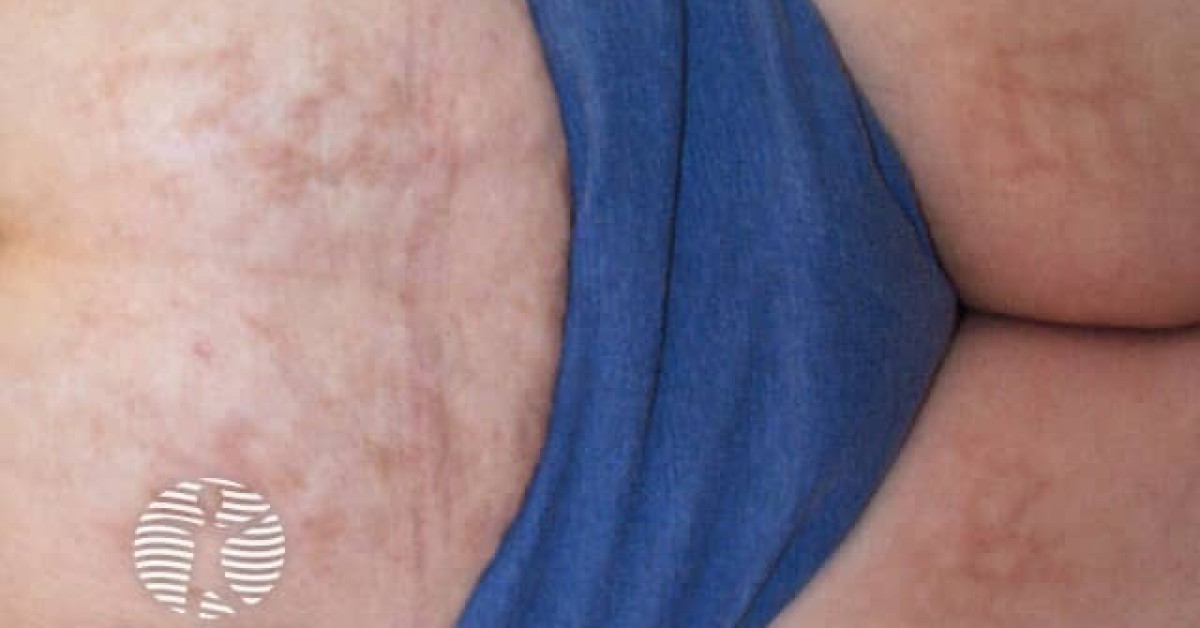
Clinical features
- Reticulated (net-like) brown-red hyperpigmented patch reflecting the underlying superficial venous plexus.
- Distribution determined by heat exposure — anterior thighs (laptop), abdomen (hot-water bottle), thighs / buttocks (heated car seat), back (electric heating pad), shin (radiator).
- Asymptomatic; sometimes burning, pruritus or paraesthesia.
- Slow development over weeks / months / years.
- Onset at any age; modern paediatric cases from laptop use rising.
- Sustained erythema, telangiectasia, epidermal atrophy and dyschromia in long-standing disease.
Modern causes
- Laptop computer — anterior thigh / lateral thigh distribution.
- Hot-water bottle — abdomen, lower back; classical in older patients with chronic pain.
- Heated car seat — thighs, buttocks; commuters.
- Electric heating pad / heat blanket — back, shoulders.
- Infrared lamp / heated work environment — bakery, glass-blowing, forging.
- Wood-burning stove / open fire — historical; legs (anterior aspect).
- Always ask specifically — patients rarely volunteer heat-source exposure history.
Malignant transformation
- Long-standing erythema ab igne carries a recognised but uncommon risk of cutaneous SCC development within the affected area — analogous to Marjolin ulcer.
- Typically arises after many years to decades of chronic heat exposure.
- Risk factors — long duration of exposure, additional UV exposure, smoking, prior radiation.
- Suspicious features — keratotic, ulcerated, indurated or rapidly enlarging area within a chronic plaque; biopsy any new component.
- Cutaneous SCC arising in EAI behaves biologically like other inflammatory-pathway SCCs — often well-differentiated but with locoregional aggressiveness.
Management
- Identify and remove the heat source — this is essential and curative for early disease.
- Reassurance for stable mild hyperpigmentation; spontaneous fading over months once heat removed.
- Cosmetic options — Q-switched laser, fractional laser; variable response.
- Topical retinoids (tretinoin 0.025–0.05%) — modest benefit for pigmentation.
- Long-standing lesions — annual skin examination; biopsy any new keratotic / ulcerated change.
- Counsel patient about heat avoidance, particularly in modern context (laptops on the lap, hot-water bottles directly on skin).
References
- Riahi RR, Cohen PR. Laptop-induced erythema ab igne — report and review. Dermatol Online J; 2012.
- Miller KH, Ott KE, Hammill RR. Squamous cell carcinoma arising in erythema ab igne — review. J Cutan Pathol; 2011.
Spot a correction?
If any clinical statement, citation or link on this page needs updating, please email admin@skinoncology.net with the page name, the proposed correction and the supporting source.