

Pre-malignantICD-10 L57.0
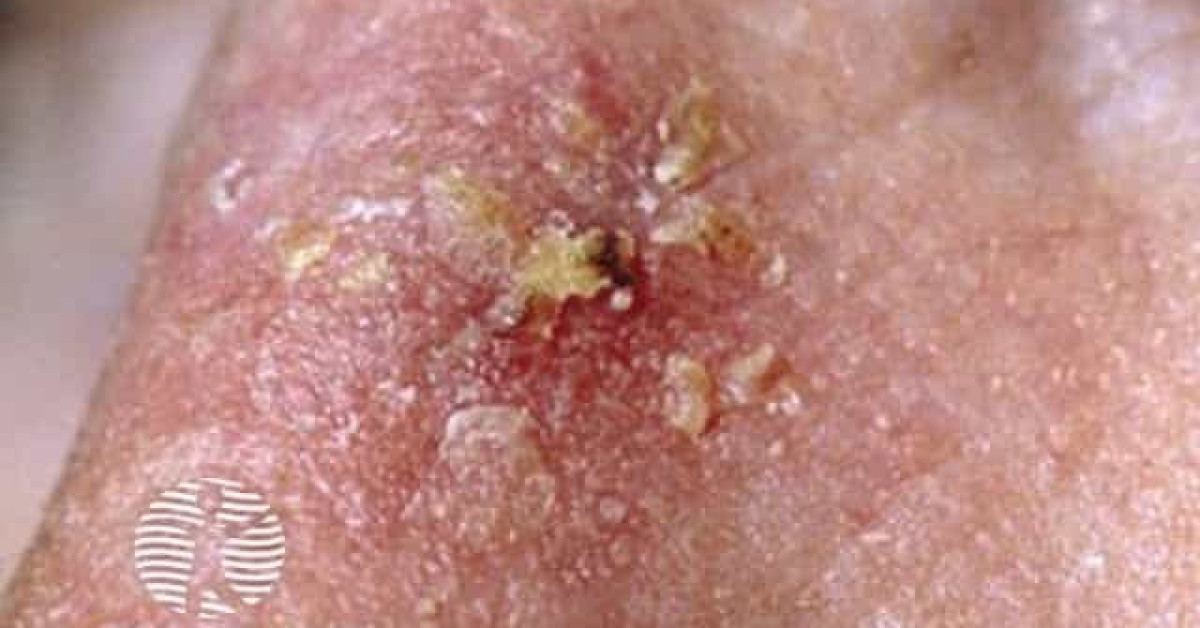
Actinic keratosis
Also known as: solar keratosis; AK
UV-induced dysplastic keratinocyte lesions — a marker of field change and, in a small proportion, a precursor of invasive cSCC. Management ranges from emollients and field therapy to cryotherapy, excision and prevention strategies.
CurrentLast reviewed 15 March 2026
Classification
The Olsen clinical grading:
- Grade 1: flat pink macule, slightly palpable ('feel, rather than see').
- Grade 2: moderately thick; both visible and palpable hyperkeratosis.
- Grade 3: very thick or hyperkeratotic; consider biopsy to exclude cSCC.
Management
Lesion-directed
- Cryotherapy — first-line for isolated hyperkeratotic AK.
- Curettage & cautery — hyperkeratotic or recalcitrant; provides histology.
- Excision — any AK suspicious for invasive cSCC.
Field therapy
- Topical 5-FU 5% — 2–4 weeks bd; brisk inflammation; highest clearance.
- Imiquimod — immune-mediated; 5%: 3×/week for 4 weeks; 3.75%: once daily as two 2-week cycles over 6 weeks.
- Diclofenac 3% gel — 60–90 days; well-tolerated, lower efficacy.
- MAL-PDT — 1–2 sessions; high clearance for thin AK.
- Tirbanibulin ointment — 5 days daily.
Prevention
- Broad-spectrum SPF 30+ daily to exposed sites; sun-protective clothing.
- Annual skin review for multiple AKs or field change.
- Nicotinamide 500 mg bd (ONTRAC) — reduces AK and cSCC incidence in high-risk patients.
UK practiceWhen to refer
Refer to secondary-care dermatology or 2WW if: rapid growth, induration, tenderness, ulceration, bleeding, immunosuppression with multiple AKs, or failure of two appropriate field therapies.
References
- de Berker D, McGregor JM, Hughes BR. British Association of Dermatologists' guidelines for the care of patients with actinic keratosis 2017. Br J Dermatol. 2017;176(1):20-43.
- Chen AC et al. A phase 3 randomized trial of nicotinamide for skin-cancer chemoprevention (ONTRAC). N Engl J Med; 2015.
Spot a correction?
If any clinical statement, citation or link on this page needs updating, please email admin@skinoncology.net with the page name, the proposed correction and the supporting source.