

Bacillary angiomatosis
BA; Bartonella vascular disease; epithelioid angiomatosis
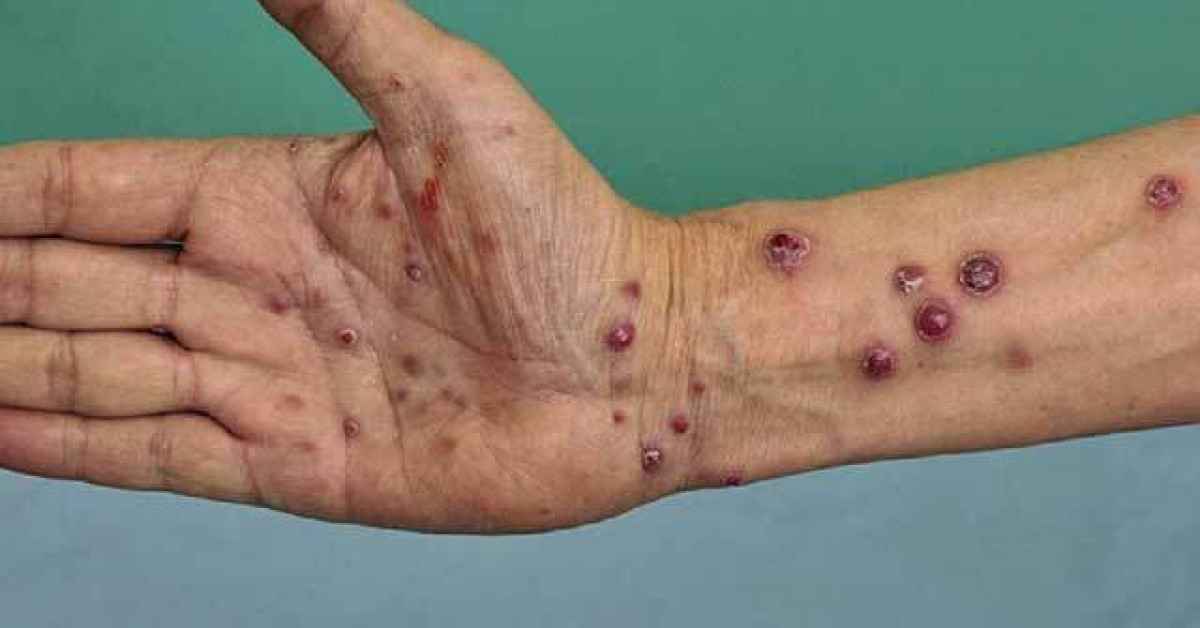
Bacillary angiomatosis is a vasoproliferative bacterial infection caused by Bartonella henselae and B. quintana, most commonly seen in HIV-positive patients with CD4 < 100, organ-transplant recipients and other immunosuppressed hosts. It presents as multiple red-purple papules and nodules that closely resemble Kaposi sarcoma and pyogenic granuloma, sometimes with visceral (hepatic = peliosis hepatis, splenic, osseous) involvement. Diagnosis requires biopsy with Warthin-Starry silver staining or bacterial PCR. Doxycycline or erythromycin for 3 months is curative in most cases; the prognosis untreated is severe.
Epidemiology
- Bartonella henselae — cat-scratch disease vector; cat / flea exposure history common.
- Bartonella quintana — body-louse vector; associated with homelessness and alcoholism.
- Predominantly in HIV-positive patients with CD4 < 100/µL; also in solid-organ transplant recipients, haematopoietic SCT recipients, malignancy.
- Less common since the widespread availability of effective antiretroviral therapy.
Clinical features
- Multiple red, purple or violaceous papules, nodules, or sometimes pedunculated lesions.
- Friable, bleeding easily, may have a collarette of scale at the base.
- Often widely distributed — face, trunk, extremities.
- Mucosal involvement — oropharynx, conjunctiva.
- Visceral involvement — peliosis hepatis (cystic blood-filled hepatic spaces), splenic disease, osteomyelitis, lymph-node disease.
- Constitutional — fever, weight loss, night sweats.
Differential diagnosis
- Kaposi sarcoma — clinically very similar in HIV-positive patients; HHV-8 / LANA-1 immunohistochemistry distinguishes.
- Pyogenic granuloma — solitary; not multiple disseminated.
- Cherry angioma — small, stable.
- Angiosarcoma — rare, slowly progressive blue-purple plaque.
- Verruga peruana (chronic B. bacilliformis) — endemic Peruvian disease.
- Kaposiform haemangioendothelioma.
Diagnosis
- Biopsy:
- Histology — lobulated proliferation of small blood vessels lined by plump epithelioid endothelial cells; characteristic interstitial neutrophilic infiltrate; granular amphophilic material.
- Warthin-Starry silver stain — clumps of darkly staining bacilli.
- Bartonella PCR (most sensitive) and immunohistochemistry where available.
- Serology — IgG titres ≥ 1:256 supportive; sensitivity variable.
- Blood culture — long incubation required (4–6 weeks); often negative.
- HHV-8 immunohistochemistry to exclude Kaposi sarcoma.
- HIV testing + CD4 count in all undiagnosed cases.
Management
- First-line — doxycycline 100 mg twice daily OR erythromycin 500 mg four times daily for at least 3 months.
- Severe disease / immunocompromised — extended duration (often 4–6 months) and consideration of rifampicin co-treatment.
- Optimisation of antiretroviral therapy in HIV-positive patients.
- Reduction of immunosuppression in OTRs (cautious).
- Lesions usually regress within weeks of effective antibiotic; failure to respond reconsiders the diagnosis.
- Lifelong follow-up where relapse risk is high.
References
- Stoler MH, Bonfiglio TA, Steigbigel RT, Pereira M. An atypical subcutaneous infection associated with AIDS. Am J Clin Pathol; 1983 (original description).
- Mosepele M et al. Bartonella infection in immunocompromised hosts — review. Clin Microbiol Rev; 2012.
- IDSA / British HIV Association — Bartonella treatment guidance.
Spot a correction?
If any clinical statement, citation or link on this page needs updating, please email admin@skinoncology.net with the page name, the proposed correction and the supporting source.