

Angioma serpiginosum
Hutchinson angioma serpiginosum
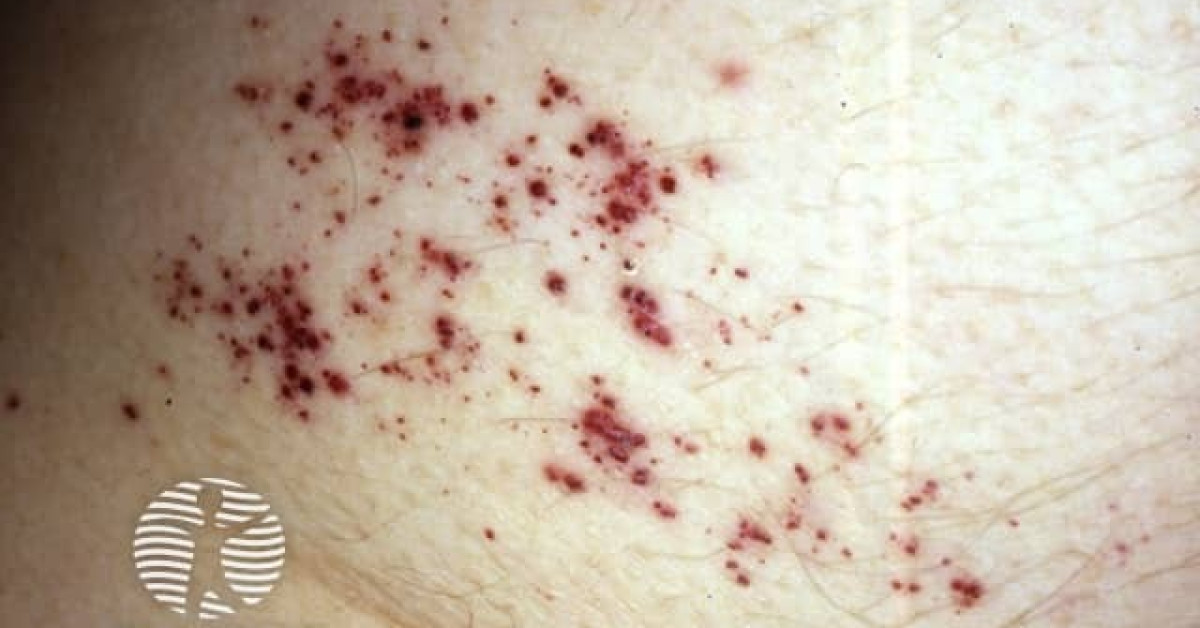
Angioma serpiginosum is a rare congenital or early-childhood vascular naevus characterised by clustered tiny pinpoint red puncta arranged in serpiginous (winding) groups that extend slowly outward over years. It predominantly affects girls (~ 90%) and most commonly involves the lower limbs and buttocks. Lesions blanch only partially / incompletely on diascopy (capillary ectasia), unlike fully blanching telangiectasia and unlike non-blanching true purpura. The principal clinical relevance in skin-oncology / dermatology clinic is as a differential for petechial / purpuric rash, capillaritis (Schamberg pigmented purpura), unilateral naevoid telangiectasia and Kaposi sarcoma. Benign and non-progressive after a slow expansion phase; cosmetic treatment with pulsed-dye laser is possible but recurrence after years is common.
Clinical features
- Clusters of tiny pinpoint red puncta (capillary ectasia) arranged in groups with a serpiginous, winding distribution.
- Blanches only partially / incompletely on diascopy (capillary ectasia) — unlike fully blanching telangiectasia and unlike non-blanching true purpura.
- Common sites — lower limbs, buttocks, abdomen; unilateral or segmental.
- Onset — childhood (most before age 10); rare congenital onset.
- Female predominance ~ 90%.
- Slow centrifugal expansion over years, then plateaus.
- Asymptomatic.
Differential
- Capillaritis / Schamberg pigmented purpuric dermatosis — cayenne pepper petechiae; broader distribution; lower limbs.
- Unilateral naevoid telangiectasia — usually upper body, V1 / V2 distribution; oestrogen-driven.
- Telangiectasia (CREST, Osler-Weber-Rendu) — blanch with pressure.
- Cherry angioma — larger discrete papules; bright red.
- Spider naevus — central arteriole with radiating vessels.
- Kaposi sarcoma — older patient / immunosuppressed; HHV-8.
- Petechiae / purpura — non-blanching but distributed and acquired.
Management
- Reassurance — benign, non-progressive after slow expansion.
- Cosmetic options for cosmetically prominent lesions:
- Pulsed-dye laser (PDL 585/595 nm) — 4–8 sessions; variable response; recurrence over years.
- Long-pulsed Nd:YAG.
- Counselling about benign nature; no cancer risk.
References
- Hutchinson J. A peculiar form of serpiginous and infective naevoid disease. Arch Surg; 1889 (original description).
- Mendiratta V, Harjai B. Angioma serpiginosum — review. Indian J Dermatol Venereol Leprol; 2005.
Spot a correction?
If any clinical statement, citation or link on this page needs updating, please email admin@skinoncology.net with the page name, the proposed correction and the supporting source.