

Actinic cheilitis
Solar cheilitis · actinic cheilosis · cheilitis actinica chronica
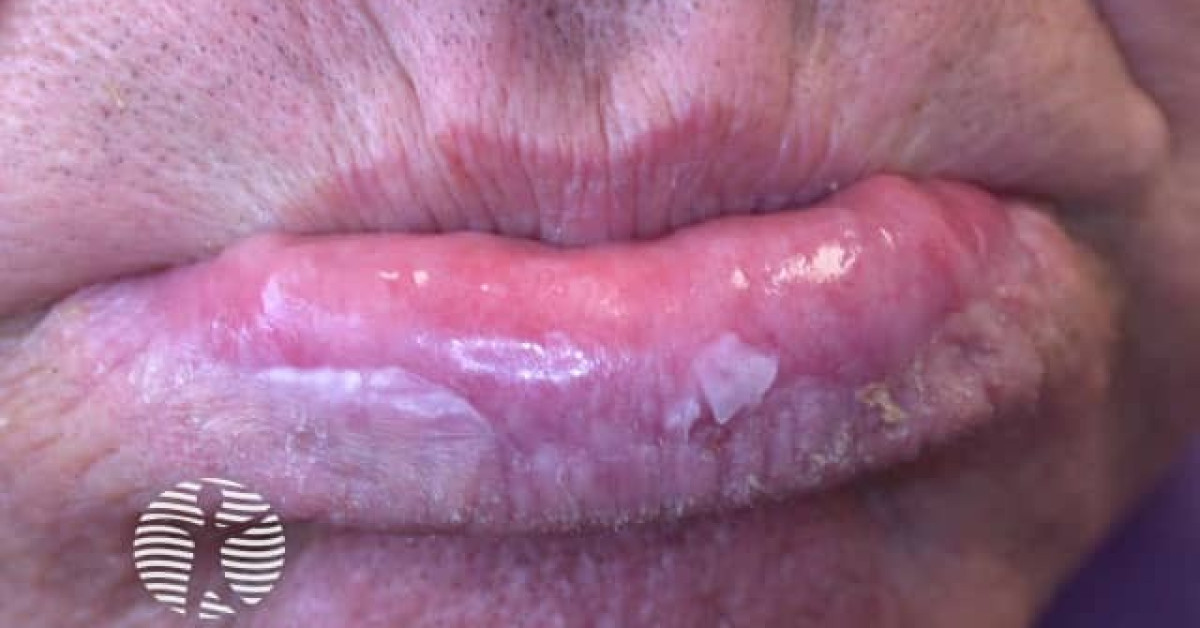
Actinic cheilitis is the lip equivalent of actinic keratosis — a UV-induced premalignant change of the vermilion border, most commonly the lower lip. Approximately 10-30% of cutaneous lower-lip SCCs arise on a background of actinic cheilitis, and lower-lip cSCC carries a higher metastatic potential than other sun-exposed cSCC. UK BAD 2020 cSCC guidelines and NICE NG12 stipulate vigilance and treatment of premalignant lip change. Management spans field treatments (5-FU, imiquimod, MAL-PDT) and surgical vermilionectomy for diffuse disease.
Risk and significance
- Cumulative UV-B damage; outdoor occupations (farmers, fishermen, sailors), light skin types, smoking.
- Older adults; men predominate.
- Lower lip far more commonly involved than upper lip (anatomic UV exposure).
- 10-30% of lower-lip cSCC arise from actinic cheilitis; lower-lip cSCC has higher metastatic potential (~10-15% vs ~3-5% for other sun-exposed sites).
- Lip cSCC is a high-risk BWH location regardless of stage.
Clinical features
- Diffuse dryness, scaling, fissuring of lower-lip vermilion.
- Loss of sharp vermilion-cutaneous border.
- Atrophy, pallor, white plaques (leukoplakia) — may overlie.
- Focal erythema, scaling, induration, persistent ulceration → red flags for invasive cSCC.
- Persistent crusts that bleed on removal.
Investigations
- Skin biopsy of indurated / persistent / ulcerated areas to exclude invasive cSCC — punch biopsy through the most clinically atypical area.
- Mapping biopsies for diffuse disease before planning treatment.
- Dermoscopy: scaly white-yellow background, telangiectasia; obliteration of normal vermilion architecture.
- Review for tobacco / sun-protection counselling.
Differential diagnosis
- Chronic cheilitis simplex — drying / wind / habit-licking.
- Allergic contact cheilitis — lipsticks, toothpaste, mango / nickel.
- Discoid lupus erythematosus of the lip — atrophy, scarring, white striations.
- Oral lichen planus — reticulate Wickham striae extending intra-orally.
- Cheilitis granulomatosa / Melkersson-Rosenthal.
- Plasma cell cheilitis.
- Invasive cSCC — single firm nodule / ulcer on a background of actinic cheilitis.
Management
- General: photoprotective lip balm SPF 30+; smoking cessation; trauma avoidance.
- Field therapies for diffuse actinic cheilitis without invasive lesion:
- 5-fluorouracil 5% cream, 1-2× daily for 2-4 weeks.
- Imiquimod 5% cream 3× weekly for 4-6 weeks.
- MAL-PDT (Metvix) — typically two sessions one week apart.
- Tirbanibulin 1% ointment (Klisyri) — actinic keratosis indication.
- Focal treatments:
- Cryotherapy for discrete lesions.
- Curettage and cautery / electrodessication.
- CO2 / Er:YAG laser ablation.
- Surgical:
- Vermilionectomy (lip shave with mucosal advancement) for diffuse / recalcitrant disease — definitive treatment with histological clearance.
- Excision biopsy of any persistent thickened / ulcerated area.
- Long-term photoprotection; clinical surveillance every 6-12 months.
References
- Salgueiro AP et al. Treatment of actinic cheilitis: a systematic review. Clin Oral Investig. 2019;23:2041-2053.
- Levi A et al. Risk factors for actinic cheilitis: a cross-sectional, observational study. J Eur Acad Dermatol Venereol. 2020;34:1290-1295.
- Keller B et al. Vermilionectomy: a modern approach. JPRAS. 2014;67:e213-e217.
- Keohane SG et al. British Association of Dermatologists guidelines for the management of people with cutaneous squamous cell carcinoma 2020. Br J Dermatol. 2021;184(3):401-414.
- NICE NG12. Suspected cancer: recognition and referral. London: NICE; 2015 (last updated 15 April 2026).
Spot a correction?
If any clinical statement, citation or link on this page needs updating, please email admin@skinoncology.net with the page name, the proposed correction and the supporting source.