

Trichoepithelioma
Brooke tumour; epithelioma adenoides cysticum; multiple familial trichoepithelioma (MFT) when multiple; desmoplastic trichoepithelioma (a histological variant)
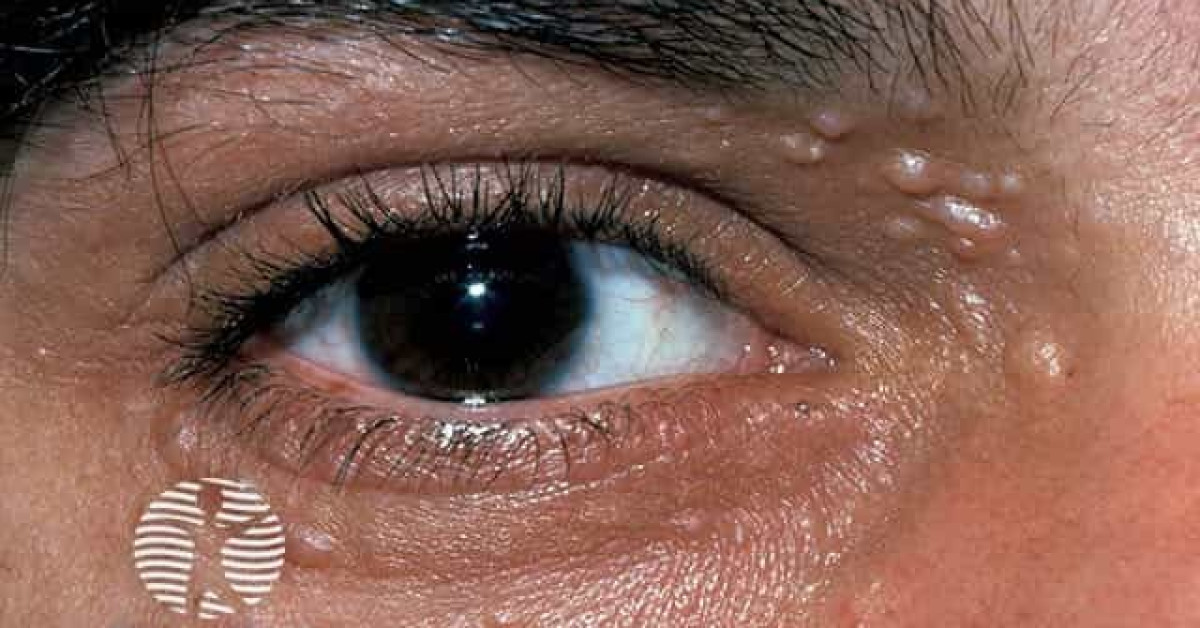
Trichoepithelioma is a benign adnexal tumour with differentiation toward the hair germ — sharing the same lineage as the trichoblastoma and overlapping morphologically with basal cell carcinoma (with which the most clinically important differential lies). The classical clinical presentation is a single skin-coloured papule on the central face (nasolabial fold, nose), or as multiple symmetrical papules concentrated around the nasolabial folds, eyelids, forehead and ears in multiple familial trichoepithelioma (MFT) — an autosomal dominant CYLD-mutation phenotype that is part of the Brooke-Spiegler / CYLD cutaneous syndrome spectrum. Histological differentiation from BCC can be difficult and is supported by adjuvant immunohistochemistry (PHLDA1, CD34, Merkel cells, BerEP4). The desmoplastic trichoepithelioma variant has its own characteristic clinical and histological features and is itself an important BCC mimic.
Clinical features
- Solitary trichoepithelioma — single skin-coloured to pink papule, 2–8 mm, on the central face (nose, nasolabial fold, cheek); slow-growing; midlife onset.
- Multiple familial trichoepithelioma (MFT) — multiple symmetrical skin-coloured papules concentrated around the nasolabial folds, central face, ears, forehead, scalp; onset in late childhood / adolescence; autosomal dominant CYLD-mutation; part of the Brooke-Spiegler spectrum (often with co-existing cylindromas / spiradenomas).
- Desmoplastic trichoepithelioma — solitary, firm, annular plaque with central depression on the face of a young woman, often misdiagnosed as morphoeic BCC.
- Asymptomatic; cosmetic concern is the usual presenting issue.
Histology & vs BCC
- Well-circumscribed dermal proliferation of basaloid germinative cells in nests and cords, with peripheral palisading and stromal induction (papillary mesenchymal bodies — clusters of fibroblasts adjacent to basaloid nests, recapitulating the developing follicle).
- Frequent horn cysts (keratin-filled microcysts).
- Symmetrical, well-circumscribed; no overlying epidermal connection; mitoses few.
- Critical differential vs BCC (often histologically difficult on superficial biopsy):
- PHLDA1 — strongly diffuse positive in trichoepithelioma; usually negative in BCC.
- CD34 — peritumoral stromal CD34 positive in trichoepithelioma; typically negative in BCC.
- CK20+ Merkel cells — present in trichoepithelioma; typically absent in BCC.
- BerEP4 — strongly positive in BCC; positive in trichoepithelioma but usually less intense.
- Architecture — symmetric, well-circumscribed, "punched-in" trichoepithelioma vs asymmetric, infiltrative BCC.
- Despite all these markers, BCC and trichoepithelioma can be genuinely histologically borderline — particularly on superficial / punch biopsy — and may need full excision for definitive diagnosis.
Multiple familial trichoepithelioma (MFT)
- Autosomal dominant CYLD-mutation disorder; one phenotype within the Brooke-Spiegler / CYLD cutaneous syndrome spectrum.
- Patients develop multiple trichoepitheliomas from late childhood, accumulating progressively.
- Typically also develop cylindromas (especially scalp) and spiradenomas — although some MFT families show predominantly trichoepitheliomas.
- Risk of malignant transformation to spiradenocarcinoma, cylindrocarcinoma or trichoblastic carcinoma in long-standing tumours — see Brooke-Spiegler syndrome.
- Genetic counselling and CYLD testing for the patient and family.
Management
- Solitary trichoepithelioma — excisional biopsy with complete histology; modest margin sufficient.
- Multiple lesions:
- CO₂ laser ablation, electrosurgery, dermabrasion — useful for many small lesions; multiple sessions; recurrence common.
- Surgical excision of larger / symptomatic / changing lesions.
- Topical / intralesional therapies (sirolimus, salicylic acid) — emerging; limited evidence.
- Annual full-skin review; biopsy any clinically changing lesion (sudden growth, ulceration, pain) to exclude malignant transformation.
- Refer to a specialist plastic / dermatological surgery team for advanced facial disfigurement.
- Genetic counselling for MFT.
References
- Bowen S et al. Mutations in the CYLD gene in Brooke-Spiegler syndrome, familial cylindromatosis, and multiple familial trichoepitheliomas. Am J Hum Genet; 2005.
- Sellheyer K et al. PHLDA1 and CD34 distinguish trichoepithelioma from basal cell carcinoma. J Cutan Pathol; 2011.
Spot a correction?
If any clinical statement, citation or link on this page needs updating, please email admin@skinoncology.net with the page name, the proposed correction and the supporting source.