

Cylindroma
Dermal eccrine cylindroma; "turban tumour" (when multiple confluent on the scalp)
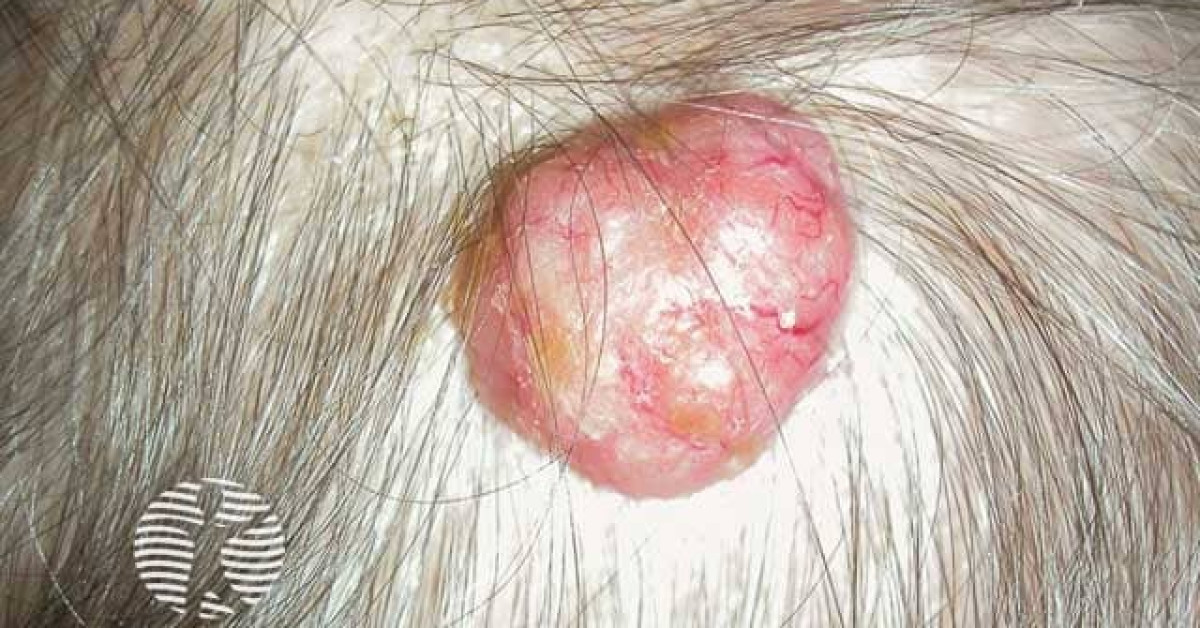
Cylindroma is a benign adnexal tumour with apocrine differentiation, classically presenting as a solitary, firm, pink-red dermal nodule on the scalp, head or neck of an adult. The far more characteristic clinical scenario is that of multiple cylindromas — pathognomonic of Brooke-Spiegler / CYLD cutaneous syndrome — accumulating over the scalp, face and trunk over decades and producing the disfiguring confluent "turban tumour" appearance from which the older name derives. Although themselves benign, long-standing cylindromas — particularly in the syndromic context — can undergo malignant transformation to cylindrocarcinoma, signalled by abrupt growth, ulceration or pain. Histology shows characteristic basaloid lobules in a "jigsaw" / "Chinese-puzzle" pattern with surrounding hyaline basement-membrane material.
Clinical features
- Solitary cylindroma — single, firm, smooth, pink-red dermal nodule, typically 1–3 cm; head, scalp, neck of an adult.
- Multiple cylindromas — dozens to hundreds of nodules accumulating over decades on the scalp, face, neck and trunk; confluence on the scalp produces the classical disfiguring "turban tumour" appearance.
- Onset typically late adolescence to early adulthood; progressive accumulation through life.
- F>M (~9:1).
- Asymptomatic; cosmetic concern, alopecia and (rarely) bleeding from larger lesions are the main issues.
- Associated tumours in syndromic patients — spiradenomas (often painful, blue-grey nodules) and trichoepitheliomas (face); see Brooke-Spiegler syndrome.
Histology
- Well-circumscribed dermal proliferation of basaloid cell lobules in a characteristic "jigsaw" / "Chinese-puzzle" pattern.
- Each lobule is surrounded by a thick eosinophilic, PAS-positive, basement-membrane-like hyaline rim.
- Two cell populations within each lobule:
- Outer small dark basaloid cells.
- Inner larger pale ductal cells.
- Hyaline droplets within the lobules.
- No atypia, no mitoses, no necrosis in benign cylindroma.
- Cylindrocarcinoma — malignant transformation; characterised by loss of the dual cell population, atypia, mitoses, necrosis, infiltrative growth.
- Differential: spiradenoma (overlapping; combined "spiradenocylindroma" common), basal cell carcinoma (lacks hyaline rim, no dual cell population), adenoid cystic carcinoma of skin.
Malignant transformation
- Lifetime risk in solitary cylindroma is very low.
- In Brooke-Spiegler syndrome, the cumulative risk of malignant transformation in one of the multiple cylindromas / spiradenomas is estimated 5–10%.
- Warning signs:
- Abrupt growth in a previously stable nodule.
- Ulceration.
- Pain.
- Bleeding.
- Discharge.
- Fixity to deeper tissues.
- Any change should prompt biopsy and re-staging.
Management
- Solitary or symptomatic cylindromas — excisional surgery with full histology; modest margin sufficient.
- Multiple lesions / "turban tumour" disease:
- Staged excision of individual lesions for symptoms or cosmesis.
- For extensive scalp involvement — total scalp excision and reconstruction with split-thickness skin graft, tissue expander or free flap (specialist plastic surgery centre); see scalp reconstruction.
- Emerging targeted topical therapy — case reports of topical sirolimus and topical tropomyosin receptor kinase inhibitors.
- Annual full-skin review; biopsy of any changing lesion to exclude cylindrocarcinoma.
- Refer to clinical genetics for CYLD testing if multiple lesions or family history; cascade testing — see Brooke-Spiegler syndrome.
References
- Rajan N et al. The genetics and management of CYLD cutaneous syndrome. Br J Dermatol; 2020.
- Massoumi R, Paus R. Cylindromatosis and the CYLD gene — biology, clinical features and treatment options. Arch Dermatol Res; 2007.
Spot a correction?
If any clinical statement, citation or link on this page needs updating, please email admin@skinoncology.net with the page name, the proposed correction and the supporting source.