

Syringoma
Eccrine syringoma; "lid" syringoma; eruptive syringoma (multiple, generalised variant)
Syringoma is a common benign adnexal tumour of eccrine ductal differentiation, presenting as multiple small skin-coloured to yellow-tan papules on the lower eyelids and periorbital skin, less commonly on the chest, neck, axillae, abdomen and vulva. The condition is benign with no malignant potential, but its clinical importance lies in the differentials — particularly distinction from microcystic adnexal carcinoma (MAC) on superficial biopsy of facial lesions, where the bland-looking ductal structures of MAC can mimic syringoma. Multiple eruptive syringomas are over-represented in Down syndrome. Treatment is cosmetic.
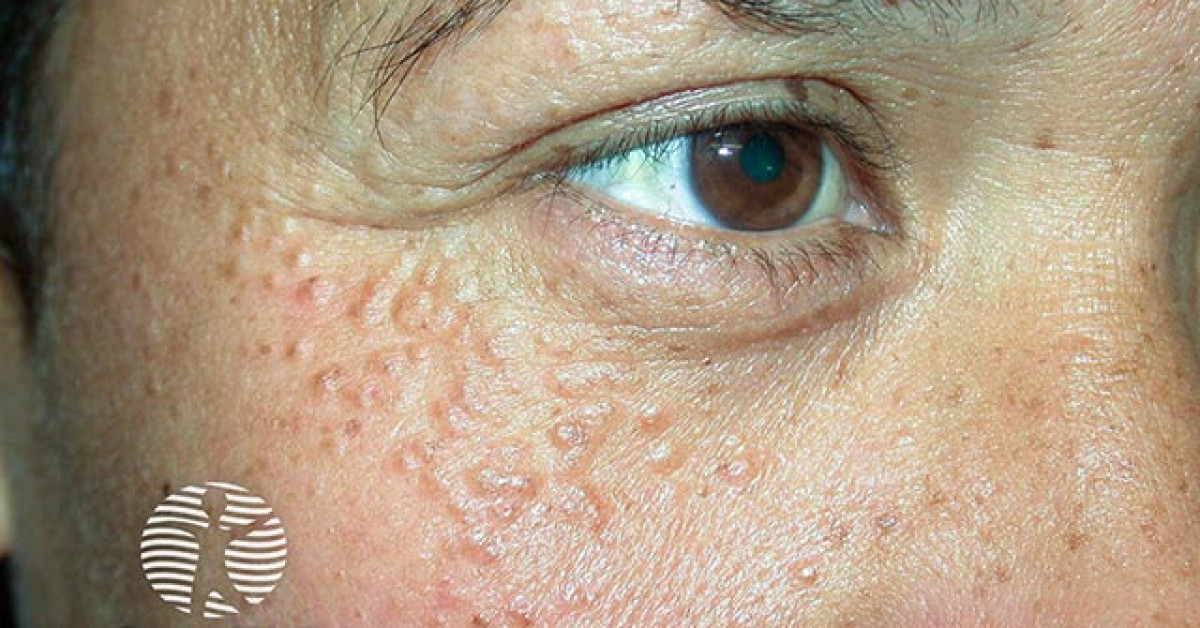
Clinical features
- Multiple small (1–3 mm), firm, skin-coloured to yellow-tan, dome-shaped papules.
- Distribution — lower eyelids and periorbital skin (~80%); also chest, neck, axillae, abdomen, vulva, penis.
- Female:male ~3:1; onset adolescence to early adulthood.
- Asymptomatic; cosmetic concern is the main presenting issue.
- Variants:
- Eruptive syringoma — abrupt eruption of dozens of lesions across trunk and limbs, usually in younger patients; over-represented in Down syndrome (5–20%) and dark-skinned populations.
- Vulval / scrotal syringoma — pruritic vulval papules, often misdiagnosed as warts or sebaceous cysts.
- Clear-cell syringoma — strongly associated with diabetes mellitus.
Histology & pitfalls
- Multiple small ductal structures in the upper / mid dermis, lined by two layers of epithelial cells with eosinophilic cytoplasm.
- "Tadpole" or "comma-tail" appearance — small ducts with a tail of solid epithelium extending into surrounding stroma — the diagnostic histological hallmark.
- Sclerotic stroma around the ducts.
- Immunohistochemistry — CK7+, EMA+, CEA+ within ducts.
- Critical pitfall — superficial biopsy of microcystic adnexal carcinoma (MAC) can mimic syringoma morphologically; MAC infiltrates deeply into subcutis and frequently shows perineural invasion, neither of which is present in syringoma. Any "syringoma-like" lesion in an unusual site (especially upper lip, central face) of an older patient warrants deep biopsy and clinical correlation.
Syndromic associations
- Down syndrome (trisomy 21) — eruptive syringomas in 5–20%; appear in adolescence.
- Marfan syndrome, Ehlers-Danlos, Costello syndrome — reported associations.
- Diabetes mellitus — clear-cell syringoma variant.
Management
- Reassurance — no treatment required for asymptomatic lesions.
- Cosmetic / functional treatment options (recurrence common):
- CO₂ laser vaporisation — the most widely used; multiple sessions.
- Erbium:YAG laser.
- Electrodesiccation.
- Trichloroacetic acid 30–50% spot peel.
- Surgical excision for solitary larger lesions.
- Topical retinoids (limited efficacy).
- Histological confirmation if diagnostic uncertainty.
- If multiple eruptive syringomas in childhood, consider Down syndrome workup if other features.
References
- Patrizi A et al. Syringoma — a review of 244 cases. Acta Dermatovenerol Croat; 1998.
- Schepis C et al. Eruptive syringomas with calcium deposits in a young woman with Down's syndrome. Pediatr Dermatol; 2001.
Spot a correction?
If any clinical statement, citation or link on this page needs updating, please email admin@skinoncology.net with the page name, the proposed correction and the supporting source.