

Sebaceous hyperplasia
Senile sebaceous hyperplasia; "sebaceous adenoma" (older — incorrect; sebaceous adenoma is a distinct neoplasm)
Sebaceous hyperplasia is one of the most common benign skin lesions in middle-aged and elderly adults — a single, soft, yellowish, often umbilicated papule on the face (forehead, cheek, nose) representing benign hyperplastic enlargement of normal sebaceous glands around a central follicular opening. Its clinical importance in skin oncology is its very common misdiagnosis as basal cell carcinoma: both share a pearly, telangiectatic, central-umbilicated appearance on the face. Dermoscopy is highly diagnostic — yellow lobular structures around a central crater with peripheral "crown" / "wreath" vessels — and reliably distinguishes sebaceous hyperplasia from BCC. Multiple sebaceous adenomas (a distinct entity) on the face should prompt consideration of Muir-Torre syndrome.
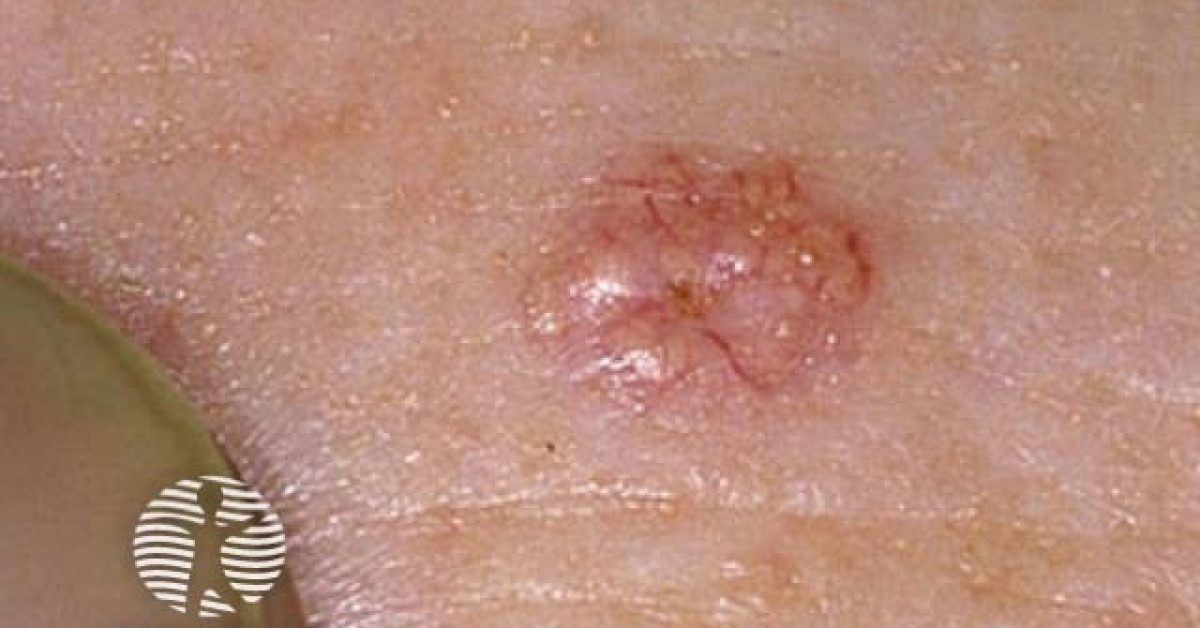
Clinical features
- Single (or several) soft, dome-shaped, yellowish to flesh-coloured papule, usually 2–5 mm, with central umbilication.
- Surface — smooth, sometimes lobulated; central crater corresponds to the dilated follicular opening.
- Distribution — face, particularly forehead, cheek, nose; less often chest, back.
- Median age 40–60 onwards; both sexes; commoner in oily-skinned, immunosuppressed (especially ciclosporin-treated transplant recipients) and elderly patients.
- Usually asymptomatic.
Dermoscopy — the BCC discriminator
- Yellow lobular structures — multiple yellow lobules ("cumulus sign" / "yellow cobblestones") radiating around a central pore.
- Central crater / umbilication — corresponds to the dilated follicular opening.
- "Crown" / "wreath" vessels — fine telangiectasias arranged at the periphery of the lesion that do not cross the centre.
- Absent — arborising vessels (BCC), blue-grey ovoid nests / leaf-like structures (BCC), pigment network (melanocytic).
- The crown-vessel pattern (peripheral, non-crossing) is the single most useful discriminator from BCC, where vessels arborise across the lesion.
Critical differential — basal cell carcinoma
- BCC — particularly the nodular subtype on the face — is the most clinically important differential.
- Discriminating features:
- BCC — pearly white-pink translucent, arborising vessels crossing the lesion, eroded or ulcerated centre, telangiectasias, blue-grey ovoid nests on dermoscopy; slow growth over months to years.
- Sebaceous hyperplasia — soft, yellow, umbilicated centre, peripheral crown vessels, no ulceration, stable for years.
- Other differentials — sebaceous adenoma (usually larger; Muir-Torre context), molluscum contagiosum (firmer, smaller, central white plug, multiple), trichoepithelioma (firm, skin-coloured, around nose / nasolabial; multiple in Brooke-Spiegler), fibrous papule of the face (firm, white, near nose).
- Biopsy any clinically uncertain lesion — the consequences of missing a BCC outweigh the small inconvenience of biopsy.
Muir-Torre context
- Sebaceous hyperplasia is benign and common — it is not a marker of Muir-Torre syndrome.
- Sebaceous adenoma (distinct entity — clinically a yellowish papule, histologically a true adenomatous neoplasm) and sebaceoma, particularly multiple, on the trunk, ARE Muir-Torre markers requiring MMR-protein testing and Lynch syndrome screening — see Muir-Torre syndrome.
Management
- Reassurance — no treatment required for typical asymptomatic lesions.
- Treatment options for cosmetic concern:
- Cautery / electrodesiccation.
- CO₂ laser ablation.
- Cryotherapy.
- Trichloroacetic acid spot peel.
- Topical retinoid (less effective).
- Oral isotretinoin in heavily affected immunosuppressed patients.
- Shave / curettage if histology desired (e.g. diagnostic uncertainty).
- Biopsy and histology if any diagnostic doubt — particularly to exclude BCC.
- In organ transplant recipients on ciclosporin, lesions may proliferate dramatically; consider conversion to alternative immunosuppression — see OTRs.
References
- Walsh N. Cumulus sign — dermoscopic feature of sebaceous hyperplasia. J Am Acad Dermatol; 2014.
- Zaballos P et al. Dermoscopy of sebaceous hyperplasia. Arch Dermatol; 2007.
Spot a correction?
If any clinical statement, citation or link on this page needs updating, please email admin@skinoncology.net with the page name, the proposed correction and the supporting source.