

Meyerson naevus
Meyerson phenomenon; "halo eczema"; "naevus with halo eczema"; (NB — entirely distinct from halo / Sutton naevus, which is an immune-mediated regression phenomenon)
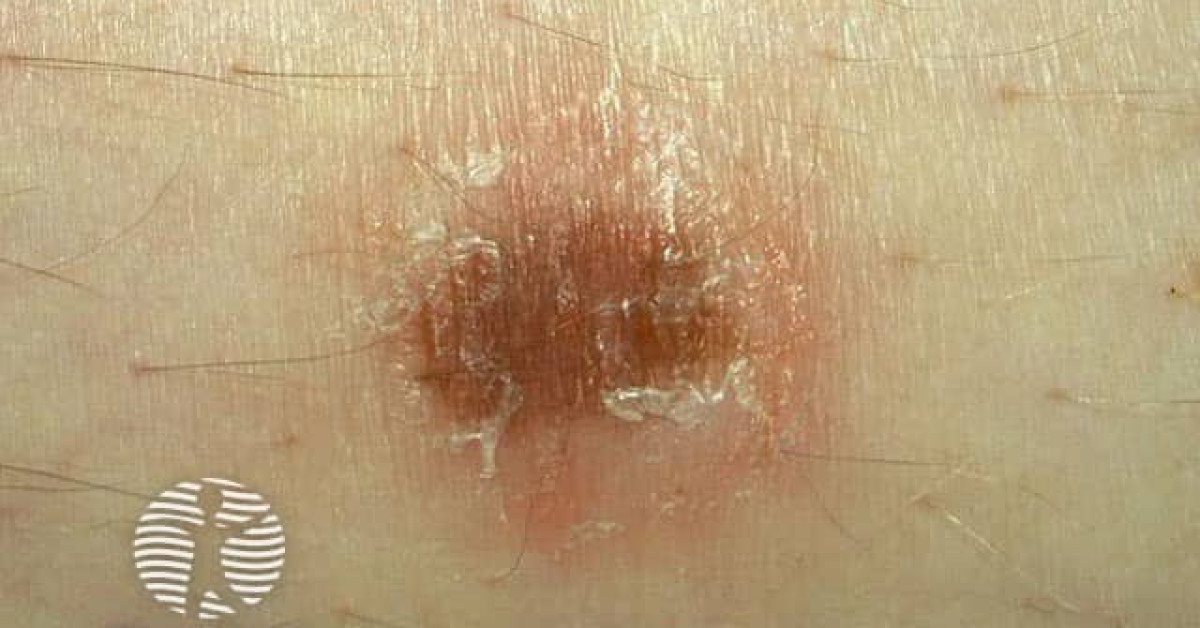
Meyerson naevus — first described by Meyerson in 1971 — is the appearance of a transient eczematous halo of erythema, scale and pruritus surrounding one or more melanocytic naevi (or, less commonly, dermatofibromas, seborrhoeic keratoses, juvenile xanthogranulomas or scars). The eczematous halo is a benign reactive process distinct from the immune-mediated regression of the halo (Sutton) naevus, and unlike that condition does not lead to depigmentation or destruction of the central naevus. The eczematous halo typically resolves within weeks with topical corticosteroid treatment, leaving the underlying naevus unchanged. Recognition matters because the central naevus need not be excised in classical Meyerson naevus — but any naevus with atypical clinical or dermoscopic features within the eczematous halo should be excised because melanoma rarely (but occasionally) presents within a Meyerson-like reaction.
Clinical features
- Eczematous halo of erythema, scale, mild oedema and pruritus surrounding one or more melanocytic naevi.
- Onset over days to weeks; the halo may be the presenting feature, drawing attention to a previously unnoticed naevus.
- Distribution — trunk and proximal limbs most common; affected naevi often within seborrhoeic distribution.
- Pruritus may be intense.
- Affects all age groups; commoner in young adults and patients with atopic background.
- Multiple naevi can be affected simultaneously (eruptive Meyerson phenomenon).
- The halo typically lasts 4–6 weeks and resolves with topical corticosteroid; the underlying naevus persists unchanged.
- Critical distinction from halo (Sutton) naevus:
- Halo naevus — depigmented (white) halo of regression; central naevus may eventually disappear; immune-mediated cytotoxic CD8+ response against melanocyte antigens; persistent.
- Meyerson naevus — eczematous (erythematous, scaly) halo; central naevus persists unchanged; benign reactive eczematous process; transient.
- The two phenomena can occasionally co-exist around the same naevus.
Histology & pathogenesis
- Spongiotic dermatitis in the surrounding skin overlying or adjacent to a typical compound or junctional melanocytic naevus.
- Lymphocytic exocytosis, parakeratosis, scale crust.
- Histology of the naevus itself is unchanged from the patient's other naevi.
- Pathogenesis incompletely understood — postulated to be a hypersensitivity reaction to local antigen / cytokine release from the naevus.
- Often co-occurs with eczema flares elsewhere.
Management
- Topical corticosteroid (potent class III–IV; e.g. mometasone furoate 0.1% once daily) for 2–4 weeks — first-line; resolves the eczematous halo within weeks while leaving the underlying naevus unchanged.
- Topical calcineurin inhibitor (tacrolimus, pimecrolimus) — alternative for facial / fold sites or steroid-sparing.
- Antihistamines for pruritus.
- Reassurance — the underlying naevus is benign; the halo is a reactive process.
- Excisional biopsy with full histology only if:
- The underlying naevus has atypical clinical or dermoscopic features (asymmetry, atypical pigment network, blue-white veil, ulceration, asymmetry of vessels).
- The halo persists despite adequate topical corticosteroid treatment.
- The patient is over 50 with new-onset Meyerson phenomenon (low threshold).
- Diagnostic uncertainty.
- Photographic surveillance of the underlying naevus during and after halo resolution.
- Counsel about photoprotection — particularly in atopic patients.
References
- Meyerson LB. A peculiar papulosquamous eruption involving pigmented nevi. Arch Dermatol; 1971.
- Nicholls DS, Mason GH. Halo dermatitis around a melanocytic nevus — Meyerson's naevus. Br J Dermatol; 1988.
Spot a correction?
If any clinical statement, citation or link on this page needs updating, please email admin@skinoncology.net with the page name, the proposed correction and the supporting source.