

Mammary Paget's disease
Paget's disease of the nipple; Paget's disease of the breast (distinct from extramammary Paget's disease)
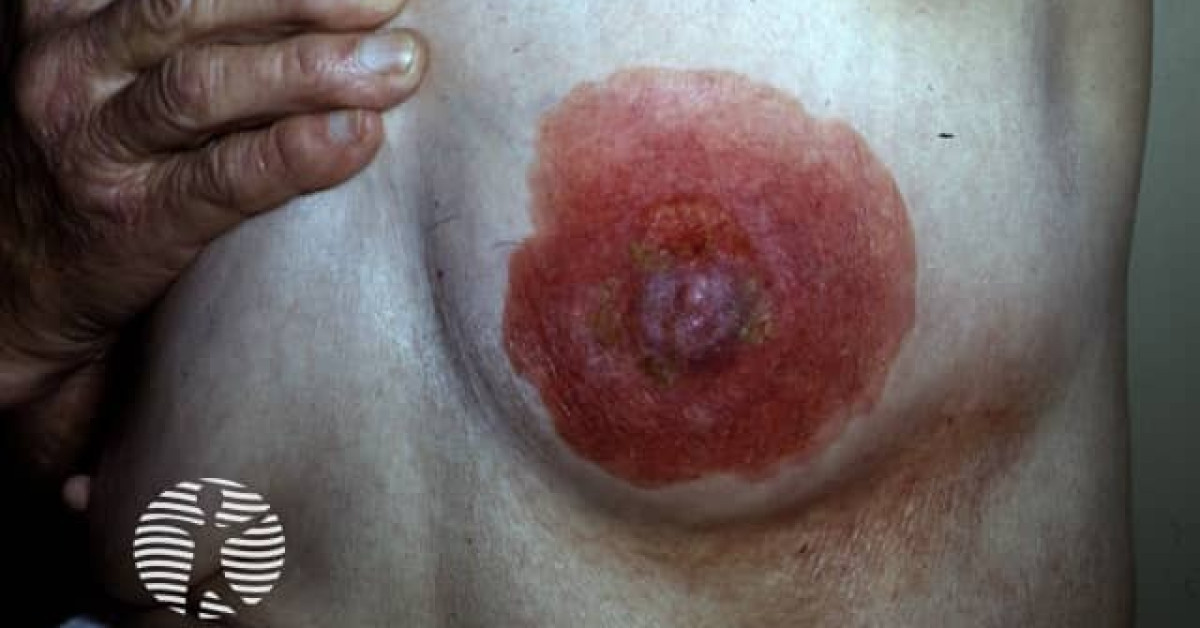
Mammary Paget's disease is an uncommon but clinically critical entity characterised by an eczematous, scaly, eroded plaque of the nipple, areola or surrounding breast skin. It represents the cutaneous manifestation of an underlying breast adenocarcinoma — almost always ductal carcinoma in situ (DCIS) and frequently invasive ductal carcinoma — that has migrated up the lactiferous ducts to involve the epidermis. Underlying breast cancer is found in >95% of cases at diagnosis, of which 50% are invasive. The "epidermotropic theory" (migration of underlying ductal carcinoma) is now favoured over the older "intra-epidermal Toker cell transformation" hypothesis. Distinguishing Paget's disease from chronic dermatitis, eczema or psoriasis on the nipple is the central diagnostic challenge — any unilateral, persistent, eczematous nipple lesion not responding to topical steroid within a few weeks demands a punch biopsy.
Clinical features
- Unilateral, slowly enlarging, well-demarcated, eczematous to scaly red plaque on the nipple and areola, sometimes extending onto surrounding breast skin.
- Pruritus, soreness, burning, bleeding, ulceration, nipple inversion or discharge.
- Median age 55–65; F:M ~50:1; men get the disease on the male nipple — often more advanced at presentation due to delayed recognition.
- An underlying palpable breast lump in ~50%; an axillary mass in ~10%.
- Always unilateral — a bilateral nipple eruption almost certainly represents eczema or psoriasis.
Differential diagnosis
- Nipple eczema / atopic dermatitis — usually bilateral, intermittent, fluctuating with the patient's general atopic flares.
- Psoriasis of the nipple — usually bilateral, with psoriasis elsewhere.
- Allergic / irritant contact dermatitis — clear precipitant (lanolin, fragrance, breast pad).
- Erosive nipple adenomatosis — benign tumour with serous discharge.
- Inflammatory breast cancer — diffuse, peau d'orange, no plaque.
- Squamous cell carcinoma in situ (Bowen's disease) — rare on nipple.
- Toker cell hyperplasia — pre-invasive intraepidermal proliferation; clinically subtle.
- Any persistent unilateral nipple eruption requires biopsy — the threshold should be very low.
Diagnosis
- Punch biopsy of the eczematous lesion — full-thickness sampling.
- Histology: large, pale "Paget cells" with abundant cytoplasm and prominent nuclei scattered throughout the epidermis, often clustering at the basal layer.
- Immunohistochemistry distinguishes from melanoma and other intraepithelial neoplasia:
- CK7+, CAM5.2+, EMA+ — Paget cells.
- HER2+ in the majority (~80–90%) — supports diagnosis.
- ER variable, PR variable, GATA3+, GCDFP-15+.
- Melan-A−, S100−, HMB-45− — excludes melanoma.
- CK20− (positive in Toker cells and in some EMPDs).
- Bilateral mammography and breast ultrasound for all patients.
- MRI of the breast for accurate extent assessment, particularly when conventional imaging is occult (~30% of cases).
- Core biopsy of any palpable or imaging-detected breast abnormality.
- Refer to breast MDT.
Management
- Treatment is determined by the underlying breast malignancy stage and biology, and should be coordinated through the breast MDT.
- Paget's disease without underlying invasive cancer or only DCIS: central wedge / cone excision of the nipple-areolar complex with breast-conservation surgery (BCS), or simple mastectomy if extensive disease — accompanied by sentinel lymph node biopsy as per breast cancer guidelines.
- Paget's disease with underlying invasive cancer: breast-conservation surgery or mastectomy plus axillary staging per breast cancer protocols.
- Adjuvant radiotherapy for breast-conservation cases.
- Systemic therapy per breast cancer biology: HER2-targeted therapy (trastuzumab) for HER2+ disease (the majority); endocrine therapy for ER+ disease; chemotherapy as indicated.
- Counselling about reconstruction options and oncoplastic approaches.
Prognosis
Determined by the underlying breast cancer stage and biology rather than by the cutaneous component. Paget's disease without underlying invasive cancer (or with DCIS only) has an excellent prognosis (5-year survival >95%). Paget's disease with invasive cancer follows the prognosis of the invasive component. Delayed diagnosis (often misdiagnosed as eczema for many months) is the principal modifiable adverse factor.
References
- Caliskan M et al. Paget's disease of the breast — review of clinical, pathological and management aspects. Breast Cancer Res Treat; 2008.
- NICE NG101. Early and locally advanced breast cancer: diagnosis and management. London: NICE; 2018 (last updated 14 April 2025).
Spot a correction?
If any clinical statement, citation or link on this page needs updating, please email admin@skinoncology.net with the page name, the proposed correction and the supporting source.