

Erythema gyratum repens
EGR; "wood-grain" eruption; "zebra-skin" eruption; "Gammel disease" (older eponym after John Gammel's 1952 description in a patient with breast cancer)
Erythema gyratum repens is a rare but visually striking paraneoplastic figurate erythema described in 1952 by John Gammel. The eruption presents as concentric, parallel, gyrate, annular bands of erythema with a distinctive trailing fine scale that migrate over the trunk and extremities at a rate of ~1 cm per day, producing a characteristic "wood-grain" or "zebra-skin" appearance widely regarded as one of the most pathognomonic skin signs of internal malignancy. Approximately 80% of cases are paraneoplastic, with lung carcinoma the leading association (~30%) followed by oesophageal, breast, gastric, cervical, prostate, bladder and other carcinomas. The eruption typically precedes cancer diagnosis by 6–12 months and resolves with successful tumour treatment, recurring with cancer relapse — a sensitive clinical marker of disease activity. Recognition of EGR by the dermatologist mandates urgent comprehensive cancer workup.
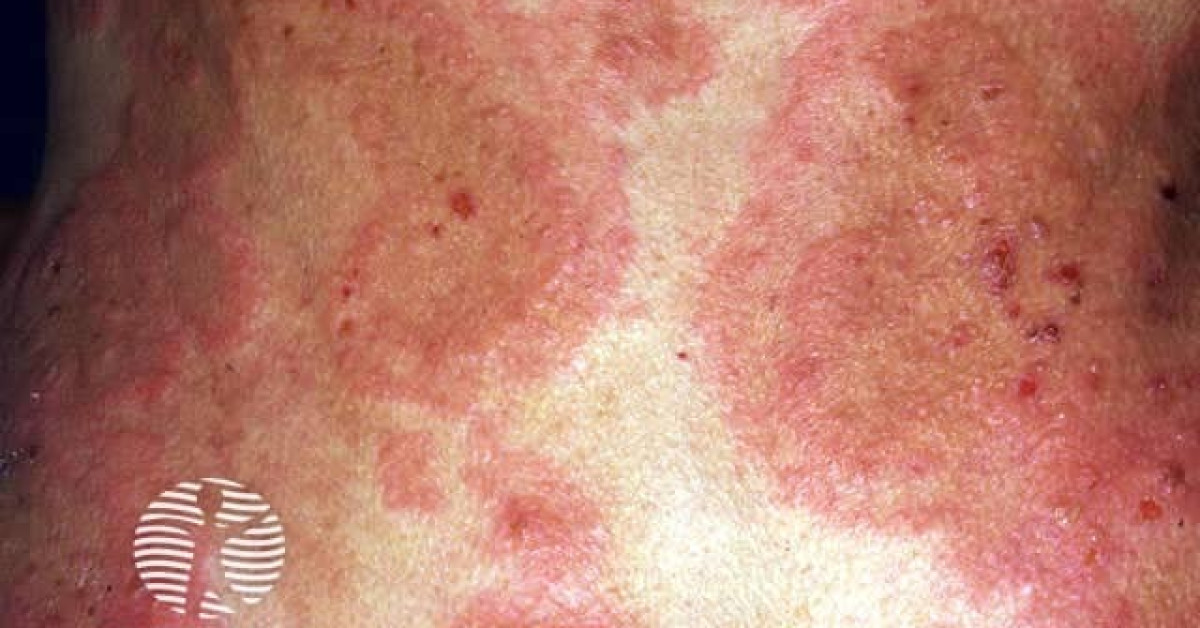
Clinical features
- Concentric, parallel, annular and gyrate bands of erythema with a fine peripheral trailing scale, producing a striking "wood-grain" / "zebra-skin" / "tigroid" appearance.
- Lesions migrate over the trunk and extremities at ~1 cm per day; constant change.
- Distribution — trunk and proximal extremities; spares face, hands and feet.
- Often pruritic.
- Median age 50–70; M>F ~3:1.
- Associated features — palmoplantar keratoderma, ichthyosis, eyebrow loss in some.
- Differential — erythema annulare centrifugum (slower migration, narrower rings, less striking pattern), urticaria multiforme, tinea corporis, mycosis fungoides (figurate variant), urticaria, secondary syphilis, drug eruption.
Underlying malignancies
- Paraneoplastic in ~80% of cases:
- Lung carcinoma — the leading single association (~30%) — particularly bronchogenic adenocarcinoma and squamous cell carcinoma.
- Oesophageal carcinoma.
- Breast carcinoma.
- Gastric, colorectal carcinoma.
- Cervical, prostate, bladder, renal carcinoma.
- Lymphoma, multiple myeloma — small minority.
- Non-paraneoplastic causes (~20%) — pulmonary tuberculosis, CREST syndrome, drug reactions (azathioprine, lenalidomide), pregnancy, idiopathic.
- EGR typically precedes cancer diagnosis by 6–12 months.
Histology
- Non-specific superficial perivascular lymphohistiocytic infiltrate.
- Mild spongiosis and parakeratosis (corresponding to the trailing scale).
- Sometimes mild interface change.
- Histology cannot distinguish EGR from other figurate erythemas — diagnosis depends on the characteristic clinical picture and identification of the underlying malignancy.
- Direct immunofluorescence — negative.
Cancer workup
- Full history and examination — particularly respiratory, gastrointestinal, weight loss, smoking history.
- FBC, U&E, LFT, calcium, ESR / CRP.
- Urinalysis.
- Stool occult blood test / FIT.
- CT chest, abdomen, pelvis — first-line; lung carcinoma is the principal target.
- Tumour markers — CEA, CA19-9, CA15-3, CA125, AFP, PSA (guided by symptoms).
- Mammography (women); cervical screening.
- Upper GI endoscopy and colonoscopy in selected patients.
- Whole-body PET-CT — increasingly used.
- Refer to lung / oncology MDT urgently.
Management
- Treat the underlying malignancy — EGR resolves with successful cancer treatment within weeks; recurrence of EGR may signal cancer relapse.
- Symptomatic skin care:
- Bland emollients.
- Topical corticosteroids — limited efficacy.
- Topical / oral retinoids — limited efficacy.
- Antihistamines for pruritus.
- Phototherapy — limited evidence.
- If exhaustive workup is negative — repeat at 6 and 12 months; EGR may precede cancer diagnosis by months to years.
- Multidisciplinary cancer care.
References
- Gammel JA. Erythema gyratum repens — a skin manifestation in a patient with adenocarcinoma of the breast. AMA Arch Derm Syphilol; 1952.
- Eubanks LE et al. Erythema gyratum repens — review. Am J Med Sci; 2001.
Spot a correction?
If any clinical statement, citation or link on this page needs updating, please email admin@skinoncology.net with the page name, the proposed correction and the supporting source.