

Anogenital warts
Condylomata acuminata · genital warts · venereal warts
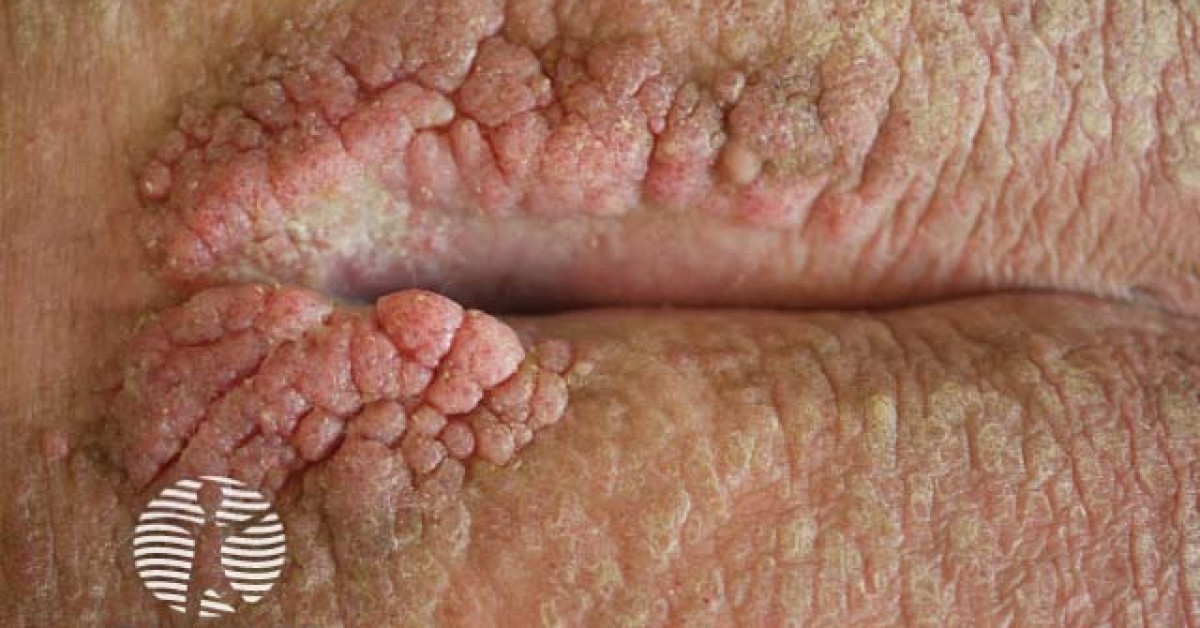
Anogenital warts are HPV-induced epithelial proliferations of the anogenital region, most commonly caused by HPV types 6 and 11 (low-risk). They affect ~1% of sexually active UK adults annually; UK HPV vaccination (Gardasil-9, since 2008-9 for girls, since 2019 for boys) has substantially reduced incidence. Although warts themselves are caused by low-risk HPV, coexistent high-risk HPV infection drives anal / cervical / vulval / penile / oropharyngeal SCC. Diagnosis is clinical; treatment is patient-administered or clinician-administered. UK BASHH guidelines underpin GUM service practice.
Aetiology and epidemiology
- HPV types: 6 (40-70%) and 11 (30-40%) account for >90%; co-infection with high-risk HPV (16, 18, 31, 33, 45) in ~20%.
- Transmission predominantly sexual (skin-to-skin); incubation 3 weeks-8 months.
- Risk factors: number of sexual partners, age 16-25, immunosuppression (HIV, transplant, biologic / ICI), smoking, lack of vaccination.
- UK HPV vaccination:
- Gardasil (HPV 6, 11, 16, 18) — initial UK programme 2008.
- Gardasil-9 (adds HPV 31, 33, 45, 52, 58) — current UK programme since 2021.
- Boys included since 2019.
- Single-dose schedule for the routine adolescent cohort (school year 8) since September 2023; immunosuppressed / HIV-positive and older-starting individuals still require multiple doses.
- UK incidence of genital warts <25 y has fallen >90% post-vaccination.
Clinical features
- Morphology:
- Cauliflower / verrucous (condyloma acuminatum) — classic.
- Flat / papular — keratinised epithelium.
- Pigmented.
- Pedunculated.
- Sites:
- Penis (shaft, glans, foreskin).
- Vulva (labia, fourchette, vestibule, clitoris).
- Vagina, cervix.
- Perianal, anal canal.
- Intraurethral.
- Buschke-Löwenstein tumour (giant condyloma) — verrucous carcinoma spectrum; risk of SCC.
- Usually asymptomatic; sometimes itching, bleeding, dyspareunia, urinary issues.
- Spontaneous resolution in ~30% within 6 months; persistence in immunosuppressed.
Differentials
- Pearly penile papules / Fordyce spots — normal anatomical variants.
- Molluscum contagiosum — central umbilication.
- Bowenoid papulosis — HPV-driven cSCC in situ.
- Condylomata lata — secondary syphilis; broad-based flat papules; serology.
- VIN / AIN / PeIN — high-grade intraepithelial neoplasia; biopsy.
- Squamous cell carcinoma (anogenital) — particularly if persistent, ulcerated, indurated.
- Verrucous carcinoma / Buschke-Löwenstein.
- Lichen planus, lichen sclerosus, psoriasis in genital region.
Investigations
- Clinical diagnosis usually adequate.
- Acetic acid 5% application — turns warts white (acetowhitening); aids visualisation but non-specific.
- Biopsy when:
- Pigmented / atypical morphology.
- Persistent / refractory treatment.
- Suspected VIN / AIN / PeIN / SCC.
- Immunosuppressed patients with extensive disease.
- STI screen at presentation per UK BASHH:
- HIV, syphilis, HBV / HCV.
- Chlamydia, gonorrhoea PCR (urethral, cervical, rectal, pharyngeal as appropriate).
- Speculum / proctoscopy for intravaginal / intra-anal disease.
- High-resolution anoscopy (HRA) in HIV-positive MSM, immunosuppressed.
- Cervical screening per UK NHS pathway.
Management (BASHH guidance)
- Patient-administered:
- Podophyllotoxin 0.15% cream / 0.5% solution: BD × 3 days, 4-day rest; cycles up to 4-5 weeks; do not use in pregnancy.
- Imiquimod 5% cream: 3× weekly overnight for up to 16 weeks; avoid in pregnancy.
- Sinecatechins 10% / 15% ointment (Veregen) — green tea extract.
- Clinician-administered:
- Cryotherapy with liquid nitrogen weekly.
- Electrosurgery (loop / hyfrecation).
- Curettage and cautery.
- CO2 / Er:YAG laser ablation.
- Excision (especially Buschke-Löwenstein).
- Trichloroacetic acid (TCA) 80-90% — pregnancy-safe.
- Buschke-Löwenstein / verrucous carcinoma: wide local excision; consider Mohs; oncology MDT.
- Adjunctive:
- HPV vaccination — therapeutic role being studied; routine vaccination strongly advocated.
- Smoking cessation.
- Treat / counsel partners.
- Use of condoms reduces but does not eliminate transmission.
- Counsel:
- Long incubation; previous partner exposure not necessarily recent contact.
- Multiple treatments often required; recurrence ~30%.
- HPV vaccination ≠ cure but reduces future related disease.
References
- British Association for Sexual Health and HIV (BASHH). UK national guideline on the management of anogenital warts 2024. London: BASHH; 2024.
- Mehta SD et al. Anogenital HPV infection: epidemiology, transmission, and risk factors. Sex Transm Infect. 2018;94:484-490.
- Drolet M et al. Population-level impact and herd effects following the introduction of human papillomavirus vaccination programmes. Lancet. 2015;385:983-996.
- Public Health England / UKHSA. Human papillomavirus (HPV) vaccination programme. London: UKHSA; 2024.
Spot a correction?
If any clinical statement, citation or link on this page needs updating, please email admin@skinoncology.net with the page name, the proposed correction and the supporting source.