

Atopic eczema
Atopic dermatitis · AD · eczema
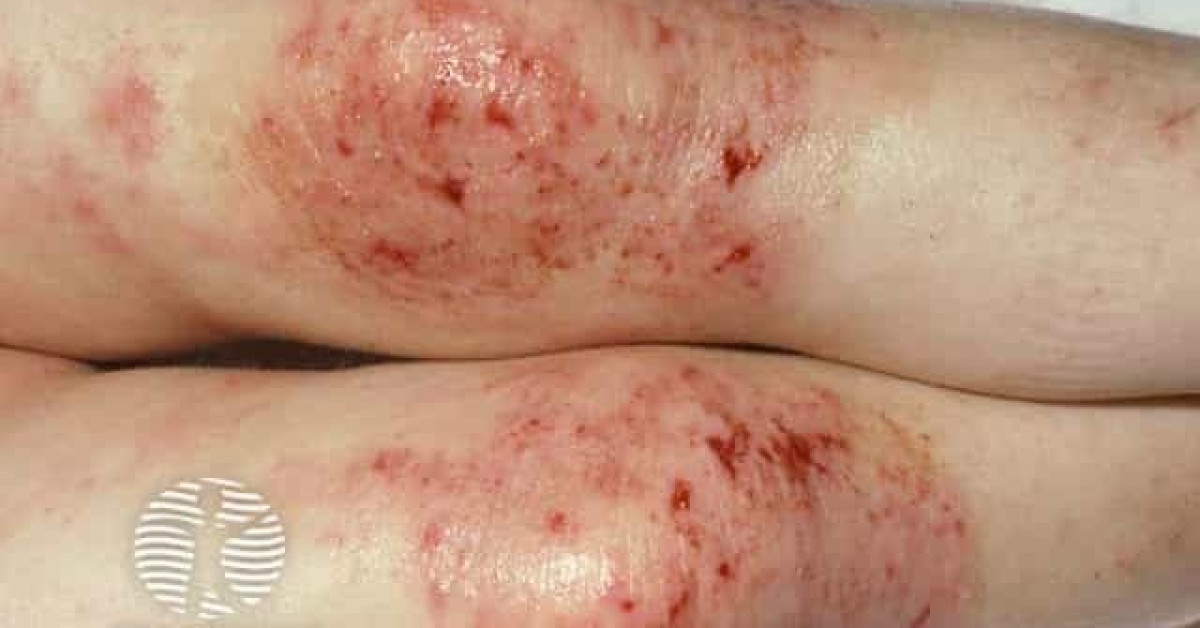
Atopic eczema is the commonest chronic inflammatory skin disease in the UK, affecting up to 20% of children and ~10% of adults. It is characterised by pruritic, ill-defined eczematous patches with a relapsing-remitting course and a typical age-related morphology. Filaggrin loss-of-function mutations, Th2-Th22 immune polarisation and skin-barrier dysfunction underpin pathogenesis. Importantly in skin-oncology practice it is the principal background for eczema herpeticum, a frequent DDx for irritant / ICI-related dermatitis, and a setting for development of cutaneous T-cell lymphoma in long-standing recalcitrant disease.
Pathogenesis
- Skin-barrier dysfunction: filaggrin (FLG) loss-of-function variants in ~30%; reduced natural moisturising factor; impaired lipid lamellae.
- Type-2 immune dysregulation: IL-4 / IL-13 / IL-31 / IL-22 drive itch, inflammation and barrier disruption.
- Microbiome dysbiosis: Staphylococcus aureus over-colonisation; reduced biodiversity.
- Atopic march: eczema → food allergy → asthma → allergic rhinitis.
- Genetic + environmental: hard water, climate, hygiene-hypothesis exposure.
Clinical features
- Pruritic erythematous patches; ill-defined; chronic-relapsing course.
- Age-related morphology:
- Infantile (0-2 years): cheeks, scalp, extensor limbs.
- Childhood (2-12 years): flexures, antecubital, popliteal, neck.
- Adult: flexures, face, neck, hands, eyelids; lichenification chronic; head-and-neck variant in young adults.
- Hanifin and Rajka diagnostic criteria; UK Working Party diagnostic criteria for prevalence studies.
- Atopic stigmata: Dennie-Morgan fold, allergic shiners, hyperlinear palms, white dermographism, pityriasis alba, keratosis pilaris.
- Complications:
- Bacterial superinfection (S. aureus) — impetiginised eczema.
- Eczema herpeticum (HSV).
- Eczema vaccinatum (rare).
- Erythroderma.
Severity assessment
- EASI (Eczema Area and Severity Index) — area + severity by body region.
- SCORAD (Scoring Atopic Dermatitis) — extent + intensity + subjective symptoms.
- POEM (Patient-Oriented Eczema Measure) — patient-reported.
- IGA (Investigator Global Assessment) — five-point.
- DLQI / CDLQI for quality of life impact.
Differential diagnosis
- Contact dermatitis (allergic / irritant) — geometric, specific exposure.
- Seborrhoeic dermatitis — greasy scale; nasolabial, scalp, central chest.
- Psoriasis — silvery scale; extensor; Auspitz sign.
- Mycosis fungoides (patch / plaque stage) — asymmetric, sun-protected, recalcitrant; biopsy + TCR.
- Scabies — burrow; web spaces; itch worse at night.
- Cutaneous T-cell lymphoma in chronic atopic patients with new fixed plaques.
- ICI-related eczematous dermatitis — drug history.
- Tinea, candidiasis, pediculosis, perioral dermatitis.
Management
- General: liberal emollients (daily, ≥250 g/week adult); soap substitutes; lukewarm baths; cotton clothing; trigger avoidance.
- Topical first-line (NICE CG57 [under 12s] / CKS):
- Topical corticosteroids — potency stepped to disease severity and site.
- Topical calcineurin inhibitors (tacrolimus 0.03% / 0.1%; pimecrolimus 1%) — steroid-sparing; face / flexure use.
- Topical PDE4 inhibitor (crisaborole — limited UK access).
- Topical JAK inhibitor (ruxolitinib cream — limited UK).
- Phototherapy: narrowband UVB; PUVA second-line.
- Systemic (moderate-severe disease):
- Ciclosporin 2.5-5 mg/kg/day; short-medium term.
- Methotrexate, azathioprine, mycophenolate mofetil — steroid-sparing.
- Short-course oral corticosteroids — flares only.
- Biologics / small molecules (UK NICE):
- Dupilumab (anti-IL-4Rα) — NICE TA534 for adults with moderate-to-severe atopic dermatitis; paediatric access should be checked against current NICE / local commissioning wording.
- Tralokinumab (anti-IL-13) — NICE TA814.
- Lebrikizumab (anti-IL-13) — NICE TA986.
- Baricitinib (JAK1/2 inhibitor) — NICE TA681.
- Upadacitinib (JAK1 inhibitor) — NICE TA814.
- Abrocitinib (JAK1 inhibitor) — NICE TA814.
- Complication management:
- Bacterial superinfection: oral flucloxacillin / topical fusidic acid (avoid long courses for resistance).
- Eczema herpeticum: empirical oral / IV aciclovir.
- Education on signs of secondary infection.
References
- NICE CG57. Atopic eczema in under 12s: diagnosis and management. London: NICE; 2007 (last updated 22 September 2025).
- Wollenberg A et al. European guideline (EuroGuiDerm) on atopic eczema 2022. J Eur Acad Dermatol Venereol. 2022;36:1409-1431.
- Simpson EL et al. Two phase 3 trials of dupilumab versus placebo in atopic dermatitis (SOLO 1 / SOLO 2). N Engl J Med. 2016;375:2335-2348.
- NICE TA534. Dupilumab for treating moderate to severe atopic dermatitis. London: NICE; 2018.
- NICE TA814. Abrocitinib, tralokinumab or upadacitinib for treating moderate to severe atopic dermatitis. London: NICE; 2022.
- Brown SJ, McLean WH. One remarkable molecule: filaggrin. J Invest Dermatol. 2012;132:751-762.
Spot a correction?
If any clinical statement, citation or link on this page needs updating, please email admin@skinoncology.net with the page name, the proposed correction and the supporting source.