

InflammatoryCommonICD-10 L70.x
Acne vulgaris
Acne · common acne
Acne vulgaris is an inflammatory pilosebaceous-unit disease affecting up to 85% of UK adolescents and persisting into adulthood in 20-40%. Pathogenesis involves four interacting factors: increased sebum (androgen-driven), abnormal follicular hyperkeratinisation, Cutibacterium acnes colonisation and inflammation. Important in skin-oncology because it is the principal DDx for EGFRi acneiform eruption, BRAFi papulopustular eruption, ICI acneiform reactions, and steroid-induced acne. NICE NG198 / 2021 underpins UK adult management.
CurrentLast reviewed 16 May 2026
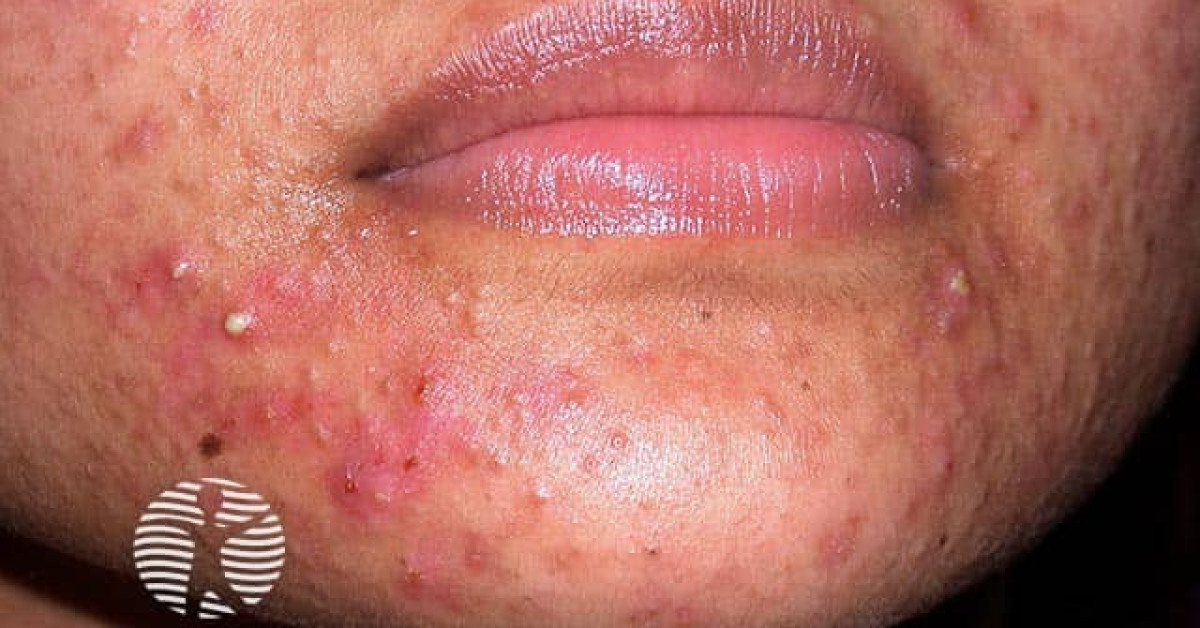
Pathogenesis
- Four interacting factors:
- Increased sebum production (androgen-driven).
- Abnormal follicular hyperkeratinisation → comedone formation.
- Cutibacterium acnes (formerly Propionibacterium) colonisation.
- Inflammation — innate (TLR-2) and adaptive immune response.
- Hormonal triggers: puberty, menstrual cycle, PCOS, androgen-secreting tumours, exogenous androgens / progestogens.
- Diet (high glycaemic index, dairy) — emerging evidence.
Clinical features
- Sites: face (forehead, cheeks, jawline), chest, upper back.
- Lesion types:
- Non-inflammatory: closed and open comedones (whiteheads / blackheads).
- Inflammatory: papules, pustules, nodules, cysts.
- Scarring: atrophic (ice-pick, rolling, boxcar), hypertrophic, keloid.
- Severity:
- Mild — comedonal ± few inflammatory.
- Moderate — many inflammatory papules / pustules; scattered nodules.
- Severe — multiple deep nodules / cysts; significant scarring.
- Variants: acne fulminans (severe ulcerative + systemic), acne conglobata, drug-induced acne, occupational, mechanical (acne mechanica), pomade.
- Adult acne: women predominantly; perimenstrual flare; mandibular distribution; hormonal pattern.
Differentials
- Rosacea (papulopustular) — no comedones; central face; telangiectasia.
- Perioral dermatitis — spares vermilion; less central face.
- Folliculitis (bacterial) — uniform follicular pustules.
- Pityrosporum folliculitis (Malassezia) — pruritic monomorphic follicular papulopustules.
- EGFRi acneiform eruption — drug history; absent comedones; pruritic.
- BRAFi / MEKi papulopustular eruption.
- Steroid-induced acne — monomorphic; truncal; topical / oral steroid history.
- Hidradenitis suppurativa — flexural; recurrent abscesses, sinus tracts.
- Pyoderma faciale (rosacea fulminans).
- Sycosis barbae, angiofibromas (tuberous sclerosis), milia.
Management (NICE NG198, 2021)
- Lifestyle: gentle skincare, oil-free cosmetics; avoid pomades / occlusive sunscreens; sleep / stress / diet education.
- Mild:
- Topical adapalene 0.1% + benzoyl peroxide 2.5% (Epiduo) OD.
- Topical clindamycin + benzoyl peroxide (Duac) OD.
- Azelaic acid 15-20% BD (pregnancy-safe).
- Moderate:
- Topical retinoid + benzoyl peroxide + oral lymecycline 408 mg OD or doxycycline 100 mg OD for 8-12 weeks.
- If acne-cycle relevance in women: combined OCP (oestrogen-containing); spironolactone 50-200 mg OD.
- Severe / scarring / treatment-resistant:
- Oral isotretinoin 0.3-1 mg/kg/day; cumulative target 120-150 mg/kg.
- Requires baseline LFTs, lipids, pregnancy prevention and UK MHRA risk-minimisation monitoring.
- Acne fulminans: oral isotretinoin + oral prednisolone overlap; specialist supervision.
- Scarring: microneedling, fractional laser, dermal fillers, surgical revision after isotretinoin clearance.
- Topical clascoterone: androgen-receptor blocker used in some markets; not a routine NHS acne treatment pathway.
- EGFRi acne management: prophylactic doxycycline 100 mg BD on starting EGFRi; topical hydrocortisone 1%; emollients.
References
- NICE NG198. Acne vulgaris: management. London: NICE; 2021 (last updated 30 April 2026).
- Zaenglein AL et al. Guidelines of care for the management of acne vulgaris. J Am Acad Dermatol. 2016;74:945-973.
- Layton AM et al. Acne vulgaris and the role of isotretinoin. Br J Dermatol. 2022;187:1-12.
- Lacouture ME et al. Skin toxicity evaluation protocol with panitumumab (STEPP). J Clin Oncol. 2010;28:1351-1357.
- British Association of Dermatologists. Implementation guide to new isotretinoin prescribing changes. London: BAD; 2023; and Changes to isotretinoin prescribing: FAQs. London: BAD; 2026.
Spot a correction?
If any clinical statement, citation or link on this page needs updating, please email admin@skinoncology.net with the page name, the proposed correction and the supporting source.